
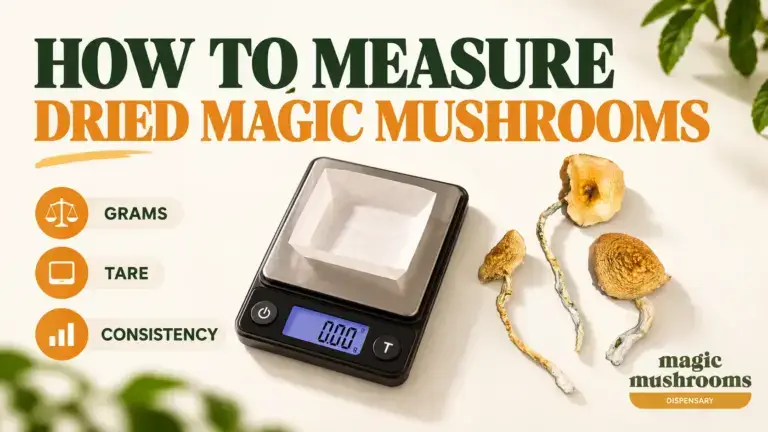
The short answer: Measure dried magic mushrooms by weight with a small digital scale that displays grams to at least 0.01 g. Put the scale on a level, stable surface, place an empty tray on it, press tare until the display returns to zero, then add the dried material slowly. Do not use a spoon, count mushrooms or judge an amount by eye.
Accurate weighing tells you the mass in front of you. It does not tell you the exact psilocybin content. Natural mushrooms vary by strain, batch and individual piece, so a careful measurement improves consistency without turning an unpredictable natural product into a laboratory-standard dose.
Before you measure
- Use only dried mushrooms from a source and species you can identify. Never consume a wild mushroom based on a photo or informal identification.
- Read the scale manual and confirm the display is set to grams, shown as g.
- Use a tray or container, then tare it to zero before adding anything.
- Measure every new portion. Similar-looking mushrooms can have very different weights.
- Do not treat a scale reading as a potency test.
Table of contents
- Why weighing matters
- What type of scale to use
- How to weigh dried mushrooms step by step
- Grams versus milligrams
- Common measuring mistakes
- Whole pieces versus powdered material
- Why weight does not equal potency
- Scale care and storage
- Frequently asked questions
Why weighing dried magic mushrooms matters
Dried mushrooms are irregular. One large stem can look lighter than several compact caps and still weigh more. A loosely filled spoon can hold a different amount each time. Even two pieces that appear almost identical can differ in density and moisture.
A scale replaces visual guessing with a repeatable mass measurement. That is useful for three reasons:
- Consistency: You can record what was actually measured instead of relying on a vague description such as one cap or one spoonful.
- Comparison: You can compare portions from the same bag and notice when an estimate was wrong.
- Harm reduction: You are less likely to take substantially more material than intended because a mushroom looked small.
The broader magic mushroom dosage guide explains general dose categories and safety considerations. This article focuses on the narrower task of measuring dried material accurately.
What type of scale should you use?
Use a compact digital scale designed for small gram measurements. A kitchen scale that changes only in whole-gram increments is too coarse for small portions. A display that reads to 0.01 g gives you clearer feedback when material is added or removed.
Display resolution is not the same as guaranteed accuracy. A scale showing two decimal places can still be poorly calibrated, placed on an unstable surface or affected by a weak battery. Choose a device with clear instructions, a tare function, an appropriate maximum capacity and a calibration procedure.
Useful scale features
- A dedicated g mode for grams
- Readability to 0.01 g
- A tare or zero button
- A flat platform large enough for a small tray
- A calibration function and compatible calibration weight
- A stable display that does not drift while the load is still
- A protective cover for storage
Very fine laboratory measurements require controlled equipment and procedures. A consumer scale is a practical tool for dried material, not a laboratory assay and not a substitute for product testing.
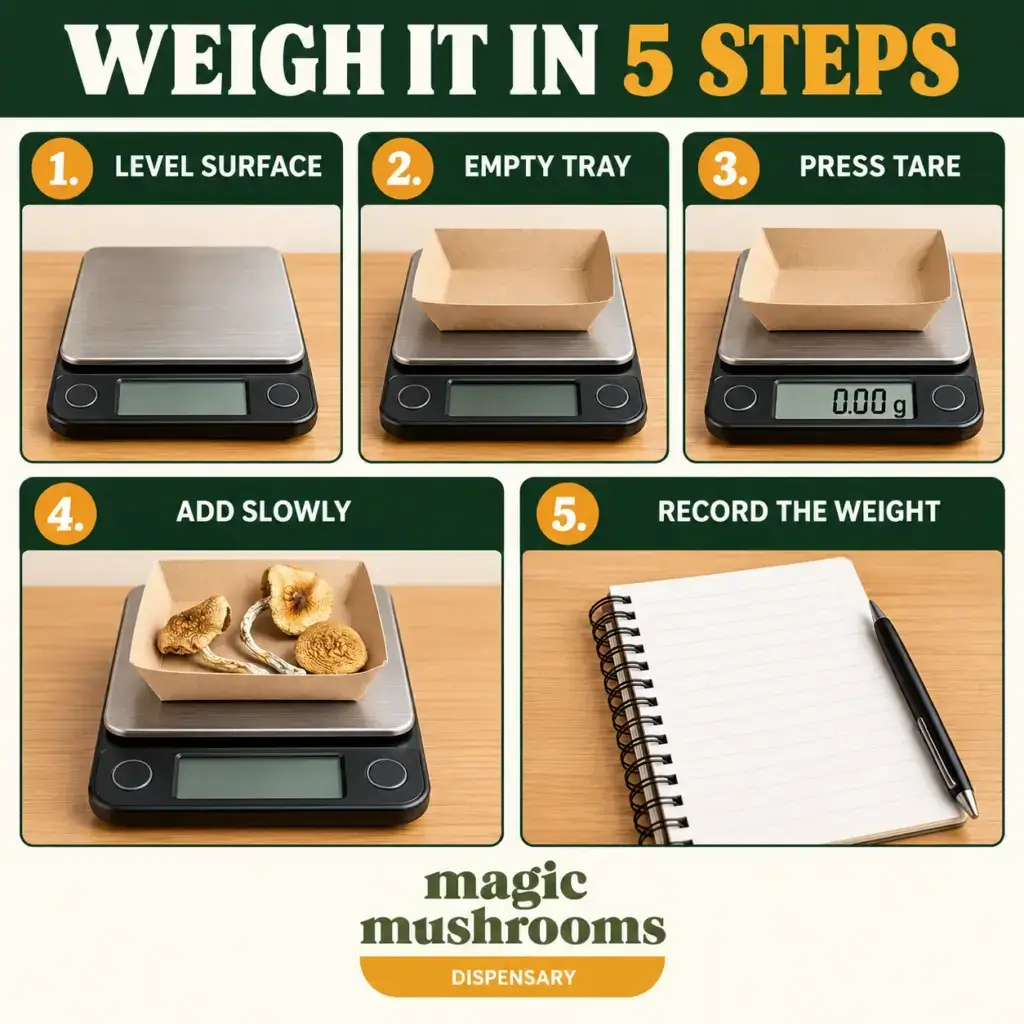
How to weigh dried magic mushrooms step by step
- Choose a stable location. Put the scale on a hard, level surface away from fans, open windows, speakers and vibration. Soft furniture and an uneven countertop can change the reading.
- Turn on the scale and select grams. Confirm the unit says g, not ounces, grains or another unit.
- Add an empty tray. A clean paper tray, weigh boat or small container keeps material off the scale platform and makes transfer easier.
- Press tare. Wait until the display returns to 0.00 g with the empty tray still in place. Tare subtracts the container weight.
- Add the dried material slowly. Let the display settle after each addition. Remove a small piece if the reading goes beyond the amount you intended to measure.
- Check the reading twice. Lift the tray, confirm the empty scale returns to zero, then place the tray back and make sure the same reading appears.
- Record the result. Note the date, product, batch if known and measured weight. Do not record a predicted effect as if it were guaranteed.
If the number drifts while nothing is moving, replace the battery, move the scale away from air movement and verify calibration. Do not keep adding material to chase a changing display.
Grams versus milligrams
One gram equals 1,000 milligrams. The abbreviations matter:
- g means grams.
- mg means milligrams.
- 0.10 g equals 100 mg.
- 1.00 g equals 1,000 mg.
Do not confuse milligrams of dried mushroom material with milligrams of purified psilocybin. They are not interchangeable measurements. Product labels may also use milligrams to describe a blend, dried mushroom equivalent or extract. Read the label to learn what the number actually represents.
For packaged products, use the product-specific label rather than converting a dried-mushroom guide into an edible or capsule amount. The shroom edibles dosage guide explains why the package total, number of pieces and amount per piece must be read separately.
Common mistakes when measuring dried mushrooms
Using a kitchen spoon
A teaspoon measures volume, not mass. Broken stems, caps and powder settle differently, so two level spoonfuls can weigh very different amounts. There is no dependable spoon-to-gram conversion for dried mushrooms.
Counting caps or whole mushrooms
One mushroom is not a standard unit. Fruiting bodies differ in size, density, moisture and chemical composition. Counting pieces is useful for inventory, not for measuring mass or potency.
Forgetting to tare the container
If the tray weighs 0.62 g and you do not tare it, the display includes both the tray and the mushrooms. Pressing tare with the empty container in place makes the display report the net weight of the material.
Using the wrong unit
Some pocket scales switch among grams, ounces, carats and grains. A number without the correct unit is not enough. Check for the small g beside the reading every time.
Weighing on an unstable surface
A couch, bed, lap or tilted table can produce inconsistent results. NIST guidance for precision scales notes that air movement, vibration and an unstable support can affect accuracy. The same practical lesson applies at home: use a rigid, quiet surface and let the display settle.
Assuming the bag is perfectly uniform
A measured gram from one part of a bag may not contain exactly the same active-compound concentration as a measured gram from another part. Accurate mass reduces one source of uncertainty. It does not remove biological variation.
Whole pieces versus powdered material
Whole dried mushrooms are easy to identify and inspect, but a small portion may include mostly stem, mostly cap or one unusually dense piece. Powdering material can make a mixed batch more physically uniform because pieces are combined before a portion is taken.
That does not mean powdered mushrooms become chemically standardized. Mixing may reduce some piece-to-piece variation within that specific batch, but it cannot reveal the psilocybin concentration or make a new batch match the last one.
Powder also has more surface area exposed to air, moisture and light. If material is ground, keep it clearly labelled, sealed and protected from children and other household members. Review the guide to storing magic mushrooms before changing the original form or container.
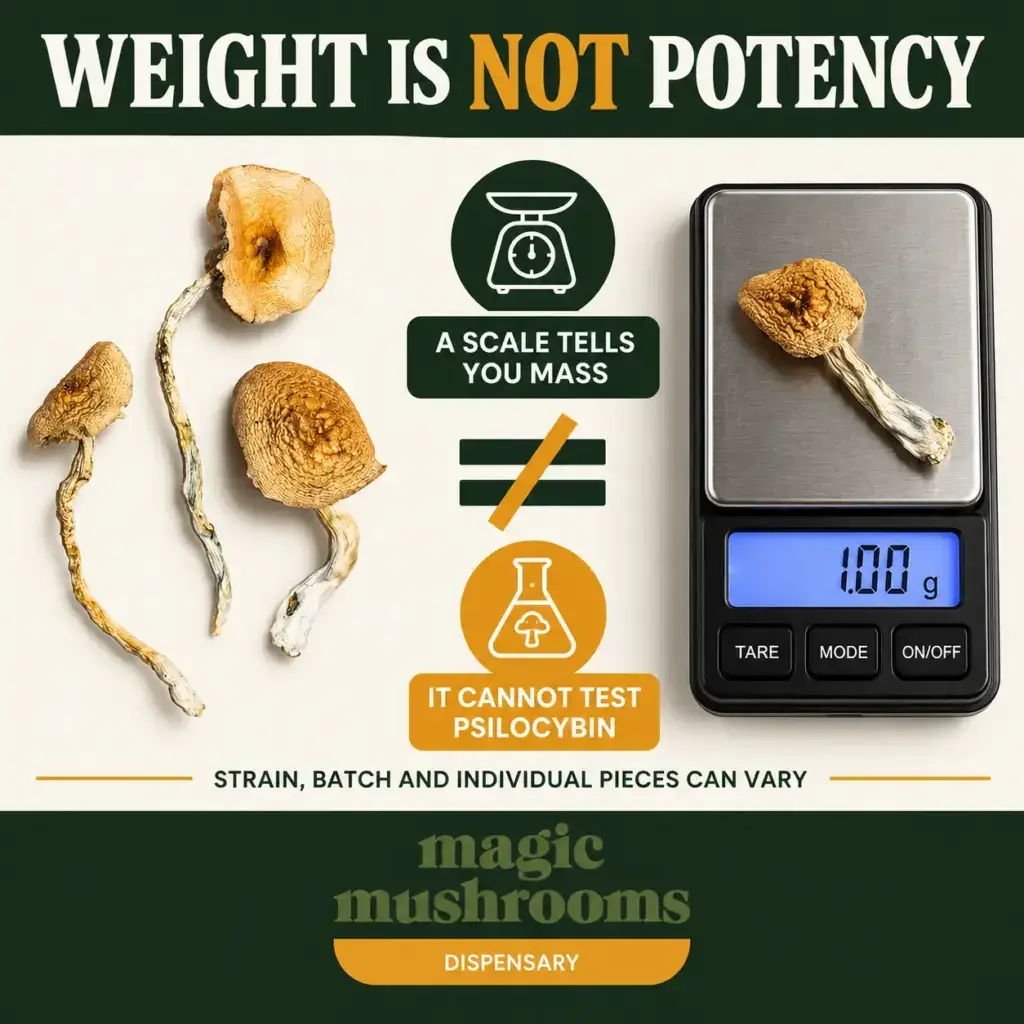
Why weight does not equal potency
A scale measures mass. It cannot identify psilocybin, psilocin or other compounds. Research has repeatedly found meaningful chemical variation in cultivated mushrooms. A controlled analysis published in 2024 found different average psilocybin and psilocin concentrations among multiple Psilocybe cubensis cultivars. Earlier controlled-culture research found psilocybin levels that varied by a factor of four across fruitings.
That variation means two portions with the same weight can feel different. Strain identity, cultivation, storage, age, the specific fruiting bodies and the person taking them can all matter. The article Do Magic Mushroom Strains Really Feel Different? explains what a strain name can and cannot tell you.
Blue bruising is also not a home potency meter. Bruising can be associated with oxidation reactions involving mushroom compounds, but colour intensity does not provide a reliable dose measurement. A dark-blue piece is not proof that it contains a specific amount.
The practical rule is simple: weigh carefully, treat each new batch as different and avoid turning a previous experience into a promise about the next one.
How to check, clean and store your scale
- Check zero before use. The empty platform should read 0.00 g.
- Use the recommended calibration weight. Follow the manufacturer’s procedure and do not substitute coins as if their mass were exact.
- Keep the platform clean and dry. Brush away loose material. Do not let liquid enter the buttons or display.
- Replace weak batteries. Low power can contribute to unstable readings.
- Protect the load cell. Do not press down on the platform or exceed the stated maximum capacity.
- Store it separately. Use the cover and keep the scale away from heat, humidity and household items that could contaminate the platform.
If a known calibration weight repeatedly gives the wrong result, stop relying on the scale until it has been recalibrated or replaced.
Frequently asked questions
Can I measure shrooms without a scale?
You can guess, but you cannot measure dried mushrooms accurately by sight, spoon volume or piece count. If the amount matters, wait until an appropriate scale is available.
Is a kitchen scale accurate enough?
Most kitchen scales read in whole grams and are too coarse for small dried-mushroom portions. A small digital scale reading to 0.01 g is more appropriate, provided it is calibrated and used correctly.
Should I weigh caps and stems separately?
Not for normal mass measurement. Caps and stems can both contain active compounds, and separating them does not produce a reliable potency estimate. Weigh the representative portion you intend to record.
Does a bigger mushroom mean it is stronger?
No. Size can increase total mass, but appearance does not reveal active-compound concentration. Weighing tells you mass only.
Can I use my phone as a scale?
No phone app can turn an ordinary touchscreen into a dependable gram scale. Use purpose-built weighing equipment.
Why does my scale keep changing?
Air movement, vibration, an uneven surface, temperature changes, a weak battery or poor calibration may cause drift. Move it to a stable surface, replace the battery and verify calibration before relying on it.
Does grinding mushrooms make each gram equally potent?
Grinding and mixing may make one batch more physically uniform, but it cannot guarantee equal active-compound distribution or standardize a different batch.
Where should a beginner start?
Start with education rather than a number. Read the first shrooms trip guide, safety and mental health information and the general dosage guide. The Golden Teacher product page explains why it is the site’s usual dried-strain starting point.
Measure the mass, respect the uncertainty
A good scale makes dried-mushroom measurement more consistent. Use grams, tare the empty container, add material slowly and verify the reading. Never use a spoon or appearance as a substitute.
Then keep the limit of the tool in mind. The display can tell you how much the material weighs. It cannot tell you exactly how potent it is or guarantee how the experience will feel. That distinction is the foundation of responsible measurement.