

The short answer: A microdose is probably too high if it causes a clear high, visual changes, impaired judgment, meaningful anxiety or difficulty doing ordinary tasks. It may be too low, or simply impossible to evaluate, when several well-tracked dose days and off days show no repeatable difference. “Just right” should not mean feeling stimulated or euphoric. It means the amount remains subtle, does not impair normal function and produces a pattern you can separate from sleep, caffeine, stress and expectation.
One dose day cannot answer the question. Microdosing research is still limited, placebo effects are substantial and mushroom potency varies. The practical approach is to track several variables, avoid changing multiple things at once and stop if effects become uncomfortable or impairing.
This article is educational, not a treatment plan. Psilocybin is not an approved therapeutic product in Canada, and nobody should stop or change prescription medication to experiment with microdosing.
Stop and get advice when a “microdose” is not behaving like one
- Do not drive or do safety-sensitive work if you feel altered, distracted, dizzy or visually affected.
- Stop taking additional doses if anxiety, agitation, insomnia or physical symptoms are building.
- Call 911 for chest pain, trouble breathing, seizure, loss of consciousness, dangerous behaviour or an immediate mental-health emergency.
- Ask a physician or pharmacist about medications and health conditions. Do not create your own medication washout.
Table of contents
- What should a microdose feel like?
- Signs a microdose may be too high
- Signs it may be too low or unclear
- What “just right” can honestly mean
- What the research shows
- Variables that can confuse the result
- How to track a microdose
- How to adjust without chasing a feeling
- Capsules versus dried mushrooms
- When to stop microdosing
- Frequently asked questions
What should a microdose feel like?
Microdosing usually refers to taking a small amount of a psychedelic that is intended to remain below a full psychedelic experience. The phrase “sub-perceptual” is common, but it can be misleading. A person may notice a subtle change without being intoxicated. The key distinction is whether ordinary perception, judgment and daily function remain intact.
A microdose should not produce obvious visuals, a strong body load, major time distortion or a need for a trip sitter. If it feels like a small trip, it is no longer functioning as a microdose for that person on that day. For what is known about months of use, see long-term side effects of magic mushrooms.
The site’s complete microdosing guide covers the definition, evidence and common schedules. This page focuses on calibration: how to tell whether the experience is too noticeable, too subtle or too inconsistent to judge.
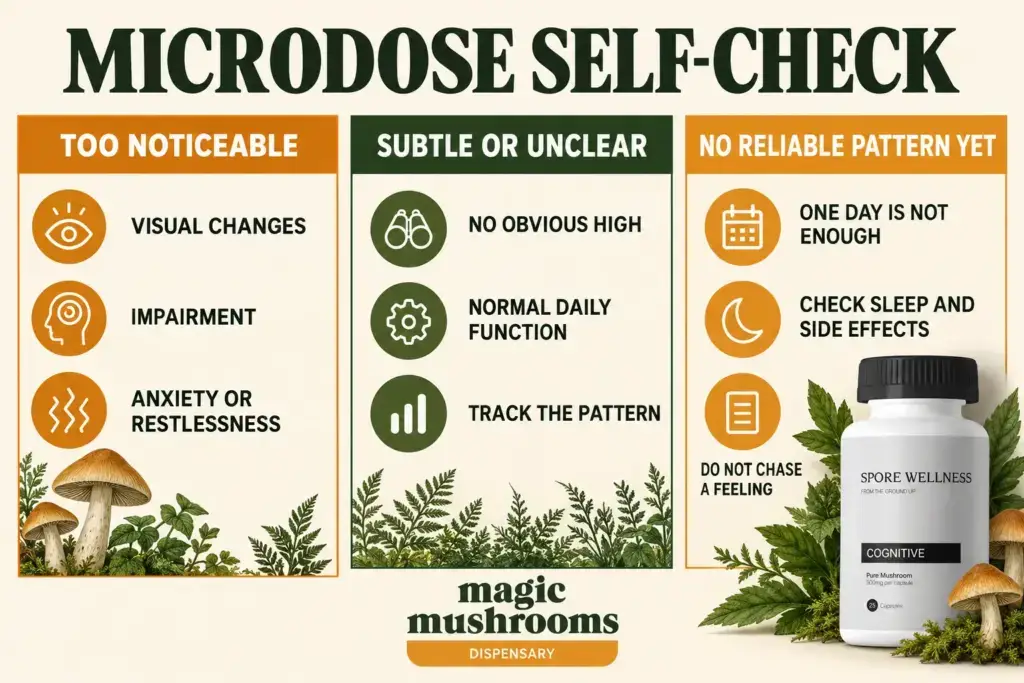
Signs your microdose may be too high
Any one of these signs deserves attention. Several together make the answer clearer.
- Visual changes. Surfaces seem to move, colours become unusually intense or peripheral vision feels altered.
- Impaired concentration. Reading, following a conversation or completing familiar work becomes harder rather than easier.
- Altered judgment. You feel unusually impulsive, overconfident or detached from ordinary consequences.
- Anxiety or restlessness. The body feels activated, thoughts race or ordinary stimulation becomes uncomfortable.
- Physical discomfort. Nausea, dizziness, headache, tremor or a noticeably racing heart interferes with the day.
- Sleep disruption. A dose taken earlier still leaves you unable to settle at night.
- Other people notice. Speech, pupils, mood or behaviour changes enough that someone asks whether you are okay.
- You should not drive. If you have to debate whether driving is safe, do not drive.
Do not take more to “balance” an uncomfortable microdose. Move to a safe setting, avoid mixing substances and let the effects pass. Persistent or severe symptoms need professional advice.
Signs it may be too low, or simply too early to judge
The absence of a noticeable high does not prove a microdose is useful, and the absence of an immediate benefit does not prove it is useless. Subtle outcomes are easy to confuse with expectation, a good night’s sleep, a quieter workday or normal mood variation.
The result is better described as unclear when:
- Only one dose day has been tried.
- The product, amount or time changed from one dose day to the next.
- Sleep, caffeine, alcohol, cannabis or stress varied substantially.
- The desired outcome was not defined in advance.
- Notes were written from memory days later.
- Only dose days were recorded, with no off-day comparison.
- The expected benefit was vague, such as “feel better” or “be more creative.”
Do not respond to an unclear result by repeatedly increasing the amount. Improve the observation first. If there is still no useful pattern after a consistent tracked period, “this may not be doing anything meaningful for me” is a valid conclusion.
What does “just right” honestly mean?
There is no scientifically established universal sweet spot for dried mushroom microdosing. A responsible working definition has three parts:
- Function remains normal. No high, visual change or meaningful impairment.
- The pattern is repeatable. A specific, modest difference appears more than once and is not limited to a single exciting day.
- The tradeoff is acceptable. Sleep, anxiety, appetite, headache and other side effects do not outweigh any perceived benefit.
A feeling of strong energy is not automatically evidence of a better microdose. Neither is euphoria. An amount that is pleasant but clearly intoxicating may be a low psychedelic dose, not a microdose.
People also need different goals. Someone tracking task initiation should not use the same success measure as someone tracking rumination or social ease. Write the intended outcome in plain language before looking for it.
What does microdosing research show?
The evidence is mixed and does not support a promise that microdosing reliably improves mood, focus or creativity.
A 2022 double-blind, placebo-controlled study of psilocybin mushroom microdosing found that active doses produced more noticeable subjective effects, especially among participants who correctly guessed their condition. The researchers did not find evidence of improved well-being, creativity or cognitive function and reported a few small changes in the direction of cognitive impairment.
Two newer placebo-controlled longitudinal trials published in 2025 also found no reliable improvement in behavioural or subjective outcomes after correction for multiple comparisons. Participants generally described the experience positively, but negative bodily feelings were greater in the active condition.
A 2026 single-ascending-dose study in healthy adults used known synthetic psilocybin rather than dried mushrooms. Subjective drug effects became distinguishable from placebo at higher low-dose levels, while altered-state scores remained low and cognitive performance did not show dose-dependent impairment. This is useful evidence that “low dose” and “completely unnoticeable” are not always the same. It does not establish a therapeutic microdose, and milligrams of pure synthetic psilocybin cannot be converted directly into a universal gram amount of dried mushrooms.
A 2025 systematic review found that reported microdosing side effects were usually mild, short-lived and dose-dependent, but the studies were heterogeneous and often short. Increased blood pressure, anxiety and cognitive impairment were among the reported concerns.
Bottom line: tracking matters because expectation can feel convincing, benefits are not guaranteed and a more noticeable amount is not proven to work better.
Seven variables that can confuse your microdose result
1. Product strength
Dried mushrooms can vary between strains, batches and individual pieces. A named strain is not a laboratory result. Even a carefully weighed amount does not reveal exact active-compound content.
2. Label units
A capsule label may describe dried mushroom material, a blend or another type of amount. Do not compare a package’s “milligrams” directly with milligrams of pure psilocybin in a clinical study unless the label explicitly says they measure the same thing.
3. Food and digestion
People often attribute every timing difference to food, but controlled pharmacokinetic reviews have not established a dependable food-effect rule for psilocybin. Record whether you ate, but do not use food as a precise timing calculator.
4. Recent use
Tolerance can develop with repeated psychedelic use. This is one reason popular schedules include off days. More frequent dosing does not guarantee a stronger or more useful pattern.
5. Sleep
Poor sleep can worsen attention, mood and anxiety on its own. Track bedtime, wake time and sleep quality before crediting or blaming the microdose.
6. Caffeine and other substances
Caffeine, cannabis, alcohol and stimulants can alter energy, anxiety, appetite and sleep. Combining variables makes it harder to know what caused what and may add risk.
7. Expectation
Expectation is not imaginary. It can produce a real subjective improvement. The question is whether the pattern remains useful and repeatable when you compare dose days with off days honestly.
How to track a microdose without overcomplicating it
Choose a few measures that matter to the reason you are experimenting. Record them on dose days and off days using the same simple scale or plain-language note.
| What to record | Useful question | Why it matters |
|---|---|---|
| Product and label | What exactly did I take? | Prevents accidental product switching |
| Time | When was it taken? | Connects effects and sleep to timing |
| Sleep | How rested was I before the day began? | Separates sleep effects from dose effects |
| Mood | Was mood steadier, lower or more reactive? | Creates a specific comparison |
| Focus | Did I start and finish normal tasks? | Uses behaviour rather than a vague feeling |
| Side effects | Any anxiety, nausea, headache or restlessness? | Makes tradeoffs visible |
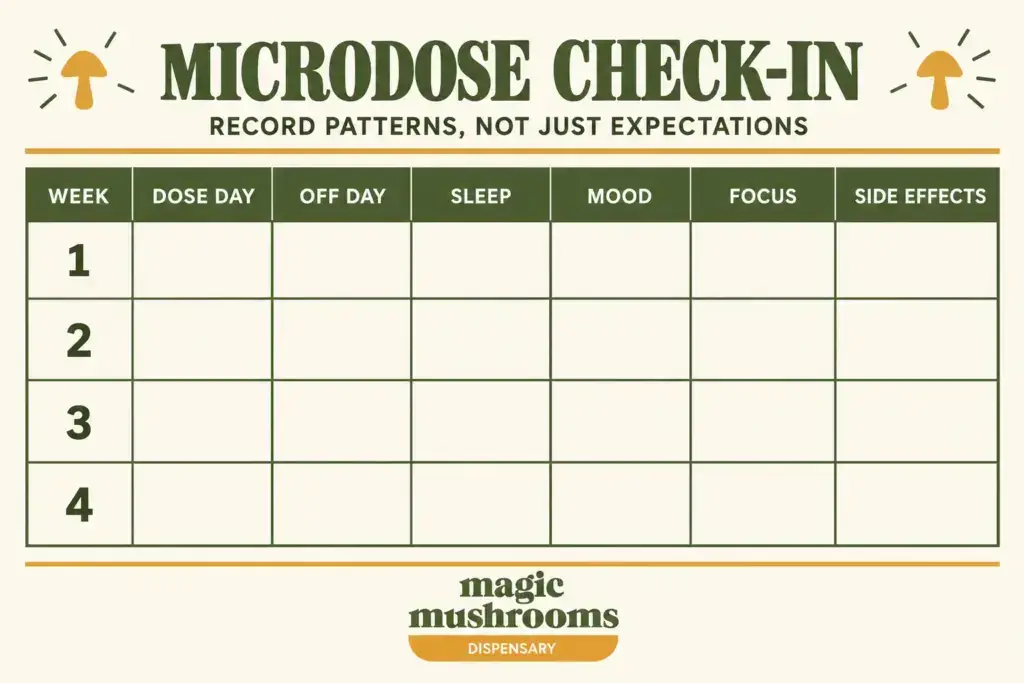
Use the blank check-in graphic for a four-week overview, then keep fuller notes beside it. The tracking section in the complete microdosing guide provides seven useful observation areas. Do not turn tracking into constant self-surveillance. One brief entry at a consistent time is more useful than checking every sensation all day.
How to adjust without chasing a feeling
If an adult has already decided to continue after reviewing the risks, use these harm-reduction principles:
- Change only one variable at a time. Keep the product, timing, caffeine and tracking method stable.
- Do not adjust during the same day. A microdose is not a signal to add more because a hoped-for feeling did not appear.
- Use off days. They provide a comparison and reduce the temptation to make every day a dose day.
- Make smaller rather than dramatic changes. Large jumps make side effects and interpretation harder.
- Pause after an uncomfortable day. Do not immediately repeat the same experiment to prove it was a fluke.
- Set a stopping rule. Decide in advance what side effect, impairment or lack of benefit will end the trial.
The Fadiman versus Stamets schedule comparison explains popular schedules without pretending that either has been proven medically superior. Off days and observation matter more than loyalty to a named protocol.
Capsules versus dried mushrooms for calibration
Capsules can make a routine simpler when each capsule in a product is intended to contain a repeatable amount. Check the current ingredients, amount, capsule count and serving information. Products are not interchangeable just because they appear in the same category.
Dried mushrooms allow a person to measure their own portion, but accurate weight is not the same as exact potency. Whole pieces can vary, and estimating by eye is unreliable. Grinding a batch may distribute material more evenly, but it still does not create laboratory-tested psilocybin content.
Magic Mushrooms Dispensary lists current options in the microdose mushroom capsules and the broader capsules category. The featured image uses the real Spore Wellness Cognitive product as a catalogue example, not as a medical recommendation. Read the current product page and package because formulations can change.
When should you stop microdosing?
Stop and seek professional advice if microdosing is linked with worsening anxiety, panic, persistent insomnia, unusual agitation, mood instability, suicidal thoughts, perceptual changes that continue after the expected window or difficulty functioning normally.
Stop immediately and get urgent help for chest pain, seizure, loss of consciousness, severe confusion, dangerous behaviour or an immediate risk of self-harm. Call or text 988 anywhere in Canada for suicide crisis support when emergency response is not required, and call 911 when danger is immediate.
Microdosing is not appropriate for everyone. A personal or family history of psychosis or bipolar disorder, pregnancy or breastfeeding, significant cardiovascular disease and interacting medications require particular caution. Review the safety and mental health guide and the medication interaction guide.
Frequently asked questions
How do I know if my microdose is too high?
Clear visual changes, intoxication, impaired concentration or judgment, meaningful anxiety, restlessness or sleep disruption suggest the amount is too noticeable to function as a microdose for you.
What if I feel absolutely nothing?
That may be expected for a subtle dose, or it may mean there is no useful effect. Compare several well-tracked dose days and off days before drawing a conclusion. Do not increase the amount after one quiet day.
Should a microdose improve focus immediately?
Not necessarily, and controlled trials have not shown reliable cognitive improvement beyond placebo. Define focus behaviourally, such as starting and completing a planned task, rather than waiting for a strong sensation.
Can a microdose make me anxious?
Yes. Anxiety and restlessness can occur, particularly as effects become more noticeable. Stop adding substances, avoid driving and reassess whether continuing makes sense.
Can I microdose every day?
Daily use makes tolerance and interpretation harder. Popular schedules use off days, but no commercial schedule is a proven medical treatment. The safest answer is not to treat daily psilocybin as a routine wellness supplement.
Are capsules more accurate than dried mushrooms?
Capsules may provide more repeatable portions when manufacturing and labels are reliable. They still differ in ingredients and what the stated milligrams represent. Dried mushroom weight also cannot reveal exact psilocybin content.
Should I stop my antidepressant before microdosing?
No. Do not stop, skip or taper a prescription to intensify psilocybin. Ask the prescriber or a pharmacist about the specific medication and health history.
How long should I track before deciding?
Long enough to compare more than one dose day with off days while keeping major variables reasonably consistent. The goal is a repeatable pattern, not a fixed number of days. Stop sooner if there is impairment or a concerning side effect.
Calibration begins with honesty, not intensity
A strong sensation is not proof that a microdose is working. A quiet day is not proof that it failed. The useful question is whether a subtle, repeatable pattern appears without impairment or unacceptable side effects.
Track a few meaningful variables, include off days and be willing to conclude that the result is unclear or not worthwhile. That is better calibration than continually increasing the amount until something dramatic happens.