

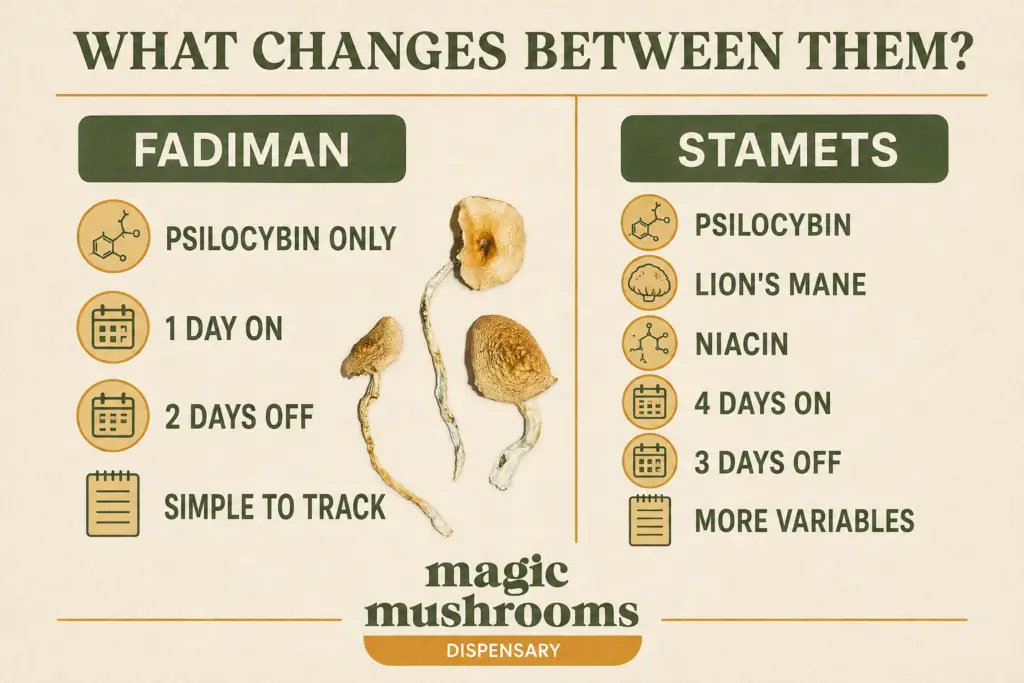
The short answer: The Fadiman and Stamets microdosing schedules are community-developed frameworks, not clinically proven treatment plans. The Fadiman protocol is commonly described as one microdosing day followed by two days without a microdose. The current version of the Stamets protocol is usually described as four days on and three days off, with psilocybin combined with lion’s mane and niacin.
One is simpler and leaves more space between microdosing days. The other is more frequent and adds two ingredients. Neither has won a head-to-head clinical trial or been shown to produce better results.
This guide compares the schedules, explains what researchers have and have not found, and gives you a practical way to track the same measures over four weeks. If you are new to the subject, begin with what microdosing is before comparing protocols.
Fadiman vs Stamets at a glance
- Fadiman: One day on, two days off. The usual framework involves psilocybin alone and emphasizes observing the microdosing day and the days after it.
- Stamets: Commonly four days on, three days off. The stack adds lion’s mane and niacin, which creates more variables and more supplement safety questions.
- Evidence: No controlled trial has directly compared the two protocols. Placebo-controlled microdosing studies have produced mixed and often null results.
- Practical difference: Fadiman is easier to track because it changes fewer things at once. Stamets follows the same weekdays but requires separating the effects of three ingredients.
Table of contents
- What is a microdosing protocol?
- Fadiman vs Stamets comparison
- How the Fadiman schedule works
- How the Stamets schedule works
- What does the research say?
- How should someone compare the schedules?
- A four-week microdosing tracker
- Rest days, tolerance and breaks
- Safety and medication considerations
- Choosing a product format
- Frequently asked questions
What is a microdosing protocol?
A protocol is a repeatable schedule. It defines microdosing days, rest days, other ingredients and what will be observed. It may help reveal patterns, but it cannot guarantee that they will be positive.
Microdosing usually refers to taking an amount intended to stay below a full psychedelic experience. Mushroom potency and individual sensitivity vary. A microdose should not produce visuals or meaningful impairment. If it does, the amount is not functionally sub-perceptual for that person.
The names Fadiman and Stamets identify two popular frameworks circulated through books, talks, interviews and microdosing communities. They are not standards issued by a medical college or public health authority. They also have not been validated as treatments for depression, anxiety, attention problems or any other health condition.
The schedule is only one consideration. Product consistency, medication interactions, mental health history, driving responsibilities and honest record-keeping matter too.
Fadiman vs Stamets protocol: side-by-side comparison
| Feature | Fadiman protocol | Stamets protocol |
|---|---|---|
| Common schedule | One day on, two days off, then repeat | Four days on, three days off, then repeat |
| Calendar pattern | A rolling three-day cycle, so microdosing days move across the week | A seven-day cycle that can stay on the same weekdays |
| Common components | Psilocybin | Psilocybin, lion’s mane and niacin |
| Tracking complexity | Lower because fewer ingredients change at once | Higher because three ingredients and consecutive days may affect the record |
| Built-in observation time | Two non-microdosing days after each microdosing day | Three non-microdosing days after four consecutive days |
| Evidence status | Not established as a superior clinical regimen | The combined stack and schedule are not proven superior in controlled trials |
These are the versions most commonly discussed today. Different calendars exist, especially for Stamets, so record the exact schedule instead of relying on the name alone.
How the Fadiman microdosing schedule works
The Fadiman protocol is associated with psychologist and psychedelic researcher James Fadiman. Its familiar rhythm is:
- Day 1: Microdosing day
- Day 2: No microdose, with attention to any after-effects
- Day 3: No microdose, often treated as a return-to-baseline day
- Day 4: Begin the cycle again if continuing
The practical strength is separation. A person can compare a microdosing day with the following day and a more distant rest day. The cycle shifts across the week, helping reveal whether a change follows the microdose or simply follows Mondays, weekends or poor sleep.
The schedule also changes fewer variables. If the product, amount and other routines remain consistent, the journal is easier to interpret than a stack containing several active supplements. Simpler does not mean proven, but it does mean fewer moving pieces.
For a dedicated walk-through, including a sample calendar and journal prompts, read the complete Fadiman protocol microdose guide. Keep that page for the single-protocol details and use this page when deciding how Fadiman differs from Stamets.
What the Fadiman schedule does not tell you
The calendar cannot determine a universally appropriate amount, predict medication interactions or prove that a good day was caused by psilocybin. Increasing the amount until it is easy to feel undermines the idea of a sub-perceptual routine. Stimulation, anxiety, visual changes or impaired judgment are signals to stop and reassess.
How the Stamets stack schedule works
The Stamets protocol is associated with mycologist Paul Stamets. The version most often shared today uses four consecutive days on followed by three days off. It is usually described as a stack of:
- Psilocybin
- Lion’s mane mushroom
- Niacin, also known as vitamin B3
Older articles and graphics may show five days on and two days off. That does not mean your calendar is broken. The public description has changed over time, and online sources have preserved different versions. If tracking, record the actual days and ingredients rather than writing only “Stamets.”
The weekly pattern can stay on the same weekdays. The tradeoff is that a change cannot immediately be attributed to psilocybin, lion’s mane, niacin, expectancy or an unrelated event.
Is the Stamets stack clinically proven?
No controlled clinical trial has established that this three-ingredient stack produces better mental health or cognitive outcomes than psilocybin alone, a placebo or the Fadiman schedule. Descriptions of “synergy” are hypotheses and community claims, not settled clinical conclusions.
A large 2022 observational study followed 953 people who reported microdosing and 180 who did not. Microdosers showed small-to-medium improvements on some mood and mental health measures, but the study was not randomized or blinded. Its supplementary analyses did not find that adding lion’s mane and vitamin B3 changed mood and mental health outcomes. The authors reported an age-related association with psychomotor performance in some people using the stack, but that cannot prove the stack caused the difference. Paul Stamets was also an author, so readers should note the disclosed interests along with the observational design. You can read the open-access study in Scientific Reports.
Niacin is not a harmless delivery switch
Niacin is an essential nutrient, but supplemental nicotinic acid can cause flushing, burning, tingling, itching, headache, rash, dizziness and lower blood pressure. Higher supplemental amounts carry more serious risks. Niacin products also come in different forms and release profiles, so a number copied from a forum does not describe every supplement.
The United States National Institutes of Health niacin fact sheet notes that nicotinic acid supplements can cause flushing at relatively low supplemental amounts. This article intentionally does not provide a niacin recipe. Ask a pharmacist or qualified clinician to review the exact product, health history and medications before considering it.
What does the research say about microdosing schedules?
Researchers have not run a convincing head-to-head trial of the Fadiman vs Stamets protocol. Published work studies microdosing more broadly, often with different substances and schedules. An observational survey cannot be treated like a blinded clinical trial.
Several well-known studies also show why expectancy matters:
- A 2021 self-blinding citizen-science study followed 191 participants. Psychological measures improved after starting the experiment in both microdose and placebo groups, with no significant overall difference between them. The authors concluded that anecdotal benefits may be partly explained by expectations. Read the full study in eLife.
- A 2022 double-blind, placebo-controlled study of 34 people using psilocybin mushrooms found noticeable acute effects and a higher likelihood of correctly guessing the condition. It did not find evidence that the microdoses improved wellbeing, creativity or cognition. The researchers said expectancy likely contributed to reported benefits. See the PubMed record.
- Another double-blind, placebo-controlled psilocybin study did not find evidence of improved emotion processing or reduced symptoms of anxiety and depression. See the published abstract.
- A 2024 rapid review of 19 placebo-controlled studies found mixed results and concluded that available evidence could not yet determine whether microdosing effects are explained by placebo. See the rapid review.
This does not mean every report is imaginary. It shows that personal experience is vulnerable to expectation and ordinary changes in sleep, workload and mood. Consistent tracking and rest days help expose those patterns.
For a broader evidence review that separates anecdotes, observational findings and controlled trials, visit does microdosing mushrooms actually work?
How should someone compare Fadiman and Stamets?
There is no evidence-based winner. A better question is which design makes the fewest assumptions and produces the clearest record for the person discussing it with a health professional.
Fadiman may be easier to evaluate when:
- You want to change one primary variable rather than three.
- You value two non-microdosing days after each microdosing day.
- You want the schedule to rotate across weekdays and weekends.
- You are prepared to journal on rest days, not only on microdosing days.
Stamets may appeal when:
- You specifically want to understand the community-described three-part stack.
- You prefer a schedule anchored to the same weekdays.
- You understand that consecutive days and extra ingredients make cause and effect harder to separate.
- A qualified professional has reviewed niacin, lion’s mane, allergies, health conditions and medication considerations.
These are design differences, not recommendations. Anyone seeking treatment should discuss evidence-based options with a qualified professional.
Do not judge a schedule by one unusually good day
A productive morning can follow better sleep, a lighter workload, a hopeful mood or simple chance. A difficult day can follow the opposite. Look for repeated patterns across microdosing days and rest days. Record unwanted effects with the same seriousness as desired ones.
A clean comparison avoids simultaneous changes to caffeine, cannabis, alcohol, supplements and sleep whenever practical. If five habits change at once, the protocol explains very little.
A four-week microdosing tracker
The tracker below is deliberately blank. It is not a dosing prescription. Use it to record what actually happened, including skipped days and changes made after speaking with a professional.
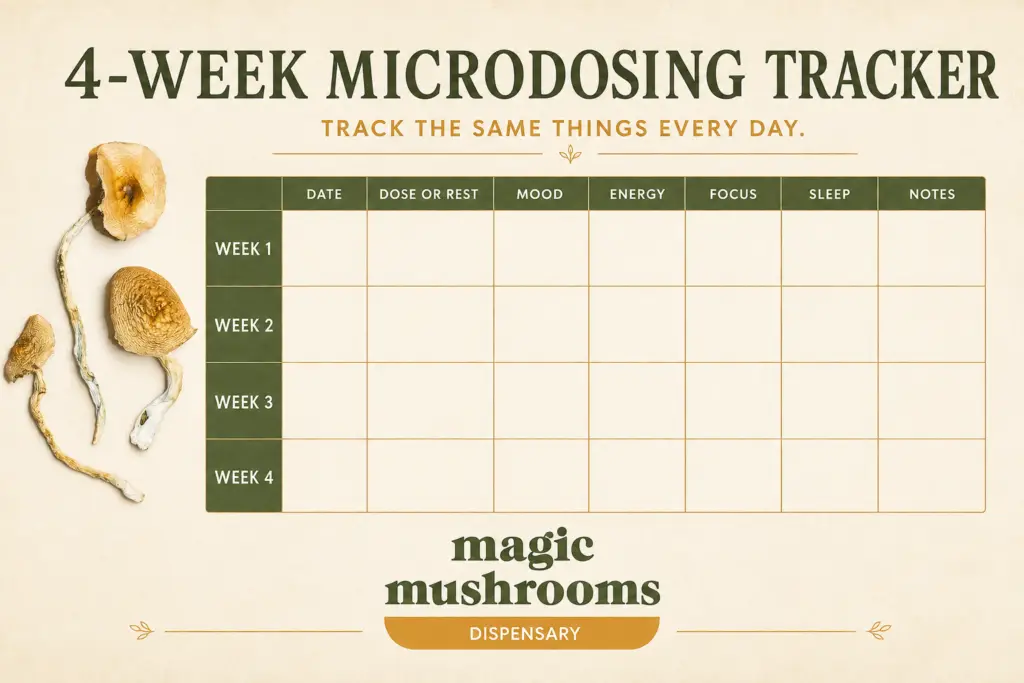
| Date | Dose or rest | Mood | Energy | Focus | Sleep | Notes |
|---|---|---|---|---|---|---|
| Week 1 | ||||||
| Week 2 | ||||||
| Week 3 | ||||||
| Week 4 |
What should you write down?
- Product and labelled amount: Record the exact product and label information. Do not rely on “one capsule” if capsule strengths differ.
- Time: Note when it was taken and when anything noticeable began.
- Sleep: Record bedtime, approximate duration and sleep quality.
- Mood, energy and focus: Use the same simple rating scale every day, including rest days.
- Context: Note work pressure, exercise, illness, menstrual cycle, major news and other factors that could change the day.
- Other substances: Record caffeine, alcohol, cannabis, medications and supplements accurately.
- Unwanted effects: Include anxiety, irritability, headache, stomach upset, insomnia, flushing, palpitations or anything else unusual.
Write observations before deciding what they mean. “Focus 7 out of 10, slept six hours, two coffees” is more useful than “the protocol worked.” The microdosing journal guide has more prompts.
Why rest days and longer breaks matter
Psilocybin can produce rapid tolerance. Repeating exposure on consecutive days may reduce noticeable effects, and cross-tolerance with other classic psychedelics can occur. Rest days are therefore part of both popular schedules, although the ideal interval for long-term microdosing has not been established by clinical evidence.
Do not respond to a less noticeable day by automatically increasing the amount. A diminishing sensation may reflect tolerance, product variability, food, sleep or expectancy. Chasing a feeling can turn a sub-perceptual plan into an impairing one.
Neither protocol should be treated as an invitation to continue indefinitely. Build in a clear review point and discuss continued use with a qualified professional. A planned break can show whether a perceived change persists and whether unwanted effects have crept in.
Safety, mental health and medication considerations
Micro does not mean risk free. Psilocybin can affect perception, anxiety, blood pressure and judgment. The evidence is especially limited for repeated unsupervised use in people with complex health histories.
Do not microdose before driving, cycling in traffic, operating equipment, supervising someone who depends on you or doing safety-sensitive work. If you notice altered perception, stimulation or impairment, step away from those tasks and do not take more.
People with a personal or family history of psychosis or bipolar disorder, those who are pregnant or breastfeeding, and people with significant cardiovascular concerns should seek individualized medical guidance and may be advised to avoid psychedelics. Anyone taking prescription drugs should have the combination reviewed by a pharmacist or doctor. Do not stop or reduce medication to make a microdosing protocol possible.
Read the full safety and mental health guide before making a decision. Health Canada also explains the legal status, risks and authorized pathways on its magic mushrooms information page. Psilocybin and psilocin remain controlled substances in Canada outside limited authorized access.
Choosing a format that is easier to track
A useful record begins with a label you can understand. Consistent, clearly labelled formats are easier to compare than breaking pieces from products without knowing the amount per piece. Capsules may be convenient for repeatability, while dried mushrooms make the underlying material visible but still vary naturally in potency.
You can review the microdose collection, browse capsules, or learn about a familiar variety on the Golden Teacher product page. The guide to mushroom strains for microdosing explains why strain names are only one part of the decision.
Before buying, compare the total amount, amount per unit, number of units and complete ingredient list. Magic Mushrooms Dispensary keeps its broader selection on the shop page, while the education hub covers onset, food, safety, storage and responsible preparation. Product availability is not medical approval, and a product page cannot replace individualized advice.
Frequently asked questions
What is the main difference between the Fadiman and Stamets protocols?
Fadiman commonly uses one microdosing day followed by two days off and usually focuses on psilocybin alone. Stamets commonly uses four days on followed by three days off and adds lion’s mane and niacin. The Stamets approach therefore has more consecutive days and more variables.
Is Fadiman or Stamets better?
No head-to-head controlled trial has shown that either is better. Fadiman is simpler to observe because it changes fewer variables. Stamets has a fixed weekly rhythm but adds supplements whose combined benefit has not been established.
What does one day on, two days off mean?
It means a microdose on the first day, no microdose on the second day and no microdose on the third day. If continuing, the next cycle begins on day four. Because this is a three-day rhythm, the microdosing day moves across the week.
Is the Stamets schedule four days on or five days on?
The version commonly discussed today is four days on and three days off. Older material often shows five days on and two days off. Record the actual schedule rather than assuming everyone using the name follows the same version.
Do I need niacin with a microdose?
No clinical evidence establishes niacin as necessary for microdosing. Supplemental nicotinic acid can cause flushing and other adverse effects, and higher amounts carry more serious risks. Ask a pharmacist or qualified clinician about the exact supplement and your medications.
Does lion’s mane make psilocybin work better?
That combination has not been proven superior in a controlled clinical trial. Observational research cannot establish that lion’s mane causes a better outcome, and one large study did not find that adding lion’s mane and vitamin B3 changed mood and mental health results.
Can I microdose every other day?
Every-other-day use is another community schedule, but it is not the standard Fadiman or Stamets pattern and has not been established as the best clinical interval. More frequent use also makes rest-day comparison and tolerance harder to interpret.
How long should a microdosing cycle last?
Research has not established one ideal cycle length for unsupervised use. Set a review point rather than continuing automatically, track unwanted effects and discuss ongoing use with a qualified professional. Longer is not automatically better.
Should a microdose be noticeable?
It should not create a full psychedelic experience or meaningful impairment. Some people may notice subtle changes, but visuals, marked stimulation, anxiety or impaired judgment mean the amount is not functionally sub-perceptual for that person.
What is the best way to tell whether a protocol is helping?
Record the same measures on microdosing and rest days, establish a baseline, keep other variables as steady as practical and include unwanted effects. Even then, a personal journal cannot rule out placebo or prove medical effectiveness.
A thoughtful protocol starts with honest uncertainty
The Fadiman vs Stamets decision is not a contest between two proven treatments. It is a comparison between a simpler rolling schedule and a more frequent three-part stack. The strongest current research does not justify promises of sharper focus, better mood or guaranteed productivity from either one.
If you are still learning, start with the microdosing pillar guide, review the evidence, read the safety information and speak with a qualified professional about medications and health history. If you choose to track an experience, use the same measures every day and let rest days count as data.
Explore more plain-language education from Magic Mushrooms Dispensary, or visit the shop only after you understand the label, local law and personal safety considerations.