
The short answer: Redosing shrooms during the same experience is unpredictable and often solves the wrong problem. If the first amount has not started working, taking more can create an unexpectedly intense overlap once both amounts take effect. If the experience is already underway, more may increase intensity, extend wakefulness or add nausea and anxiety without recreating a clean second peak. If the effects seem weak because of recent use, taking more does not make the situation reliably safe.
The lowest-risk choice is not to chase the experience with another serving. Give the first amount time, do not mix substances and use the session to observe what happened. Product strength, food, format, recent tolerance, medications and individual response can all change the timeline.
This guide explains what people mean by redosing, what the evidence does and does not show, why timing matters and what to do if you have already taken more.
Get help now if the situation is becoming unsafe
- Call 911 for chest pain, trouble breathing, seizure, loss of consciousness, severe injury, dangerous agitation or a person who cannot be woken.
- Call a poison centre when the product, mushroom, amount or mixture is uncertain. In most of Canada, call 1-844-764-7669. In Quebec, call 1-800-463-5060. In Nunavut, contact the local health centre.
- Do not drive, cook, swim, use tools or leave an impaired person alone in an unsafe setting.
- Keep the package, label and any remaining mushrooms available for identification.
Table of contents
- What does redosing shrooms mean?
- Should you redose shrooms?
- Why timing changes the risk
- Does tolerance make a redose weaker?
- Why the first amount may seem not to work
- Dried mushrooms, capsules and edibles
- What to do if you already redosed
- What not to do next
- Medications and health conditions
- A better plan for a future session
- Frequently asked questions
What does redosing shrooms mean?
Redosing means taking an additional amount after the first amount has already been consumed. People may do this because nothing seems to be happening, the effects feel weaker than expected, the peak is fading or they want the experience to last longer.
Those situations are not equivalent. Taking more before the first amount has fully developed creates a different risk from taking more late in the experience. Recent use over previous days also differs from adding more during one session. Advice that treats every redose as the same misses the most important variables.
Redosing is also not the same as following a multi-session treatment protocol in a regulated clinical study. Research sessions use screened participants, known synthetic psilocybin, controlled amounts, monitoring and trained staff. Dried mushrooms and commercial edibles can vary in active-compound content, and an unsupervised second serving adds uncertainty rather than removing it.
Should you redose shrooms?
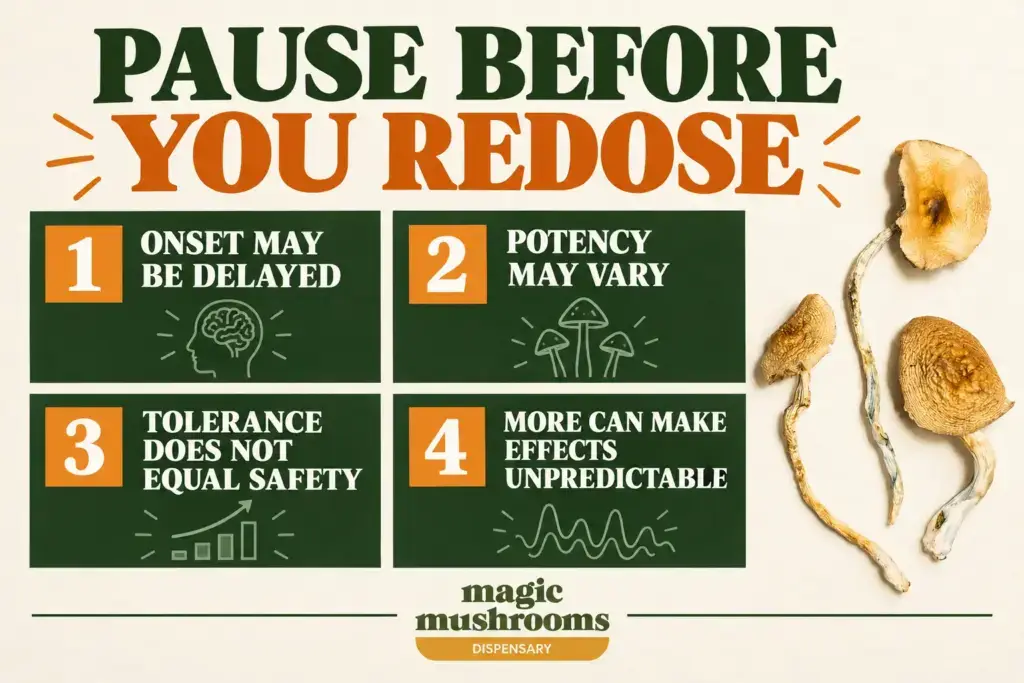
Our harm-reduction answer is no. Do not take more in the same session simply because the first amount feels slow, weak or different from what you expected. The benefits are uncertain, while the practical risks are clear: overlapping effects, more difficult anxiety, longer impairment, more nausea, delayed sleep and a harder-to-interpret experience.
This is especially important with a new product, a new batch, an edible, a capsule blend or a product whose label is unclear. If you cannot confidently state what was taken, how much the label says each piece contains and when it was taken, adding more is guesswork.
Why timing changes the risk
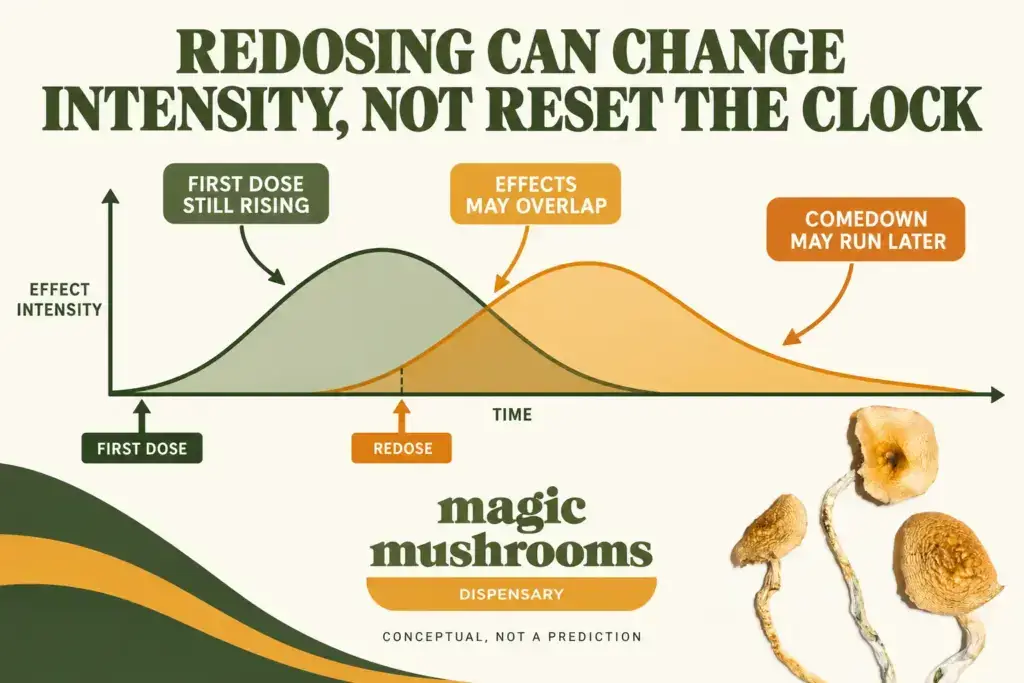
Health Canada says effects may appear within 15 to 45 minutes and usually last four to six hours. That is a broad public-health reference, not a countdown for taking more. Human pharmacokinetic research shows that psilocin concentrations after oral psilocybin often peak later, commonly around two hours in controlled studies. Real mushroom products add more variability because the amount of active compounds is not perfectly predicted by weight alone.
| When someone considers more | What may actually be happening | Main concern |
|---|---|---|
| Before noticeable effects | Absorption may still be underway, especially after food or with an unfamiliar edible | Both amounts may become active close together |
| During the rise | The first amount has not reached its strongest point | The final intensity becomes harder to predict |
| During the peak | Judgment and time perception may already be altered | Anxiety, confusion and physical discomfort may increase |
| As effects fade | The body and mind may be moving into the comedown | Wakefulness and impairment may last later without producing the desired second peak |
The complete shroom onset guide explains why the beginning can feel inconsistent. The duration and afterglow guide covers the rest of the timeline.
Does tolerance make a redose weaker?
Psilocybin can produce tolerance with repeated use. Health Canada notes that regular use over several days can reduce the desired effects. Older human research also found tolerance during repeated daily administration and cross-tolerance between psilocybin and lysergic acid diethylamide.
That does not create a reliable formula for a same-session redose. The evidence base is much stronger for tolerance developing across repeated days than for predicting what an extra serving will do during one mushroom experience. A second amount may feel weaker than expected, may overlap strongly with the first or may mostly extend stimulation and side effects. The result depends on timing, product, active-compound content and the person.
Tolerance also does not mean the body is protected from adverse effects. A person may feel less of the desired psychedelic effect while still experiencing nausea, anxiety, elevated heart rate, blood-pressure changes or impaired judgment. A 2024 systematic review of controlled therapeutic-dose studies found headache, nausea, anxiety, dizziness and elevated blood pressure more often with psilocybin than with comparators.
If mushrooms were used recently, the safer response is to stop and allow time for recovery rather than trying to overpower tolerance. Read the site’s broader magic mushroom myths and facts guide for the difference between rapid tolerance and addiction.
Why the first amount may seem not to work
A weak or delayed experience does not automatically mean the amount was too small. Common explanations include:
- The onset is slower than expected. Food, digestion and the product can shift the beginning.
- The product or label was misunderstood. Total package amount, amount per piece and suggested serving are different numbers.
- Potency varies. Dried mushrooms from the same named strain or batch may not contain identical active-compound levels.
- Recent use created tolerance. Repeated use over a short period may blunt effects.
- Storage reduced quality. Heat, moisture, air and light can damage dried products over time.
- A medication or health factor changed the response. The direction and significance depend on the specific medication and person.
- The expectation was too specific. Not every experience produces visuals, euphoria or a dramatic emotional shift.
The dedicated guide, Why Didn’t My Shrooms Work?, explains these possibilities without turning the answer into “take more.”
Does redosing differ with dried mushrooms, capsules and edibles?
Dried mushrooms
Dried mushrooms can vary from one mushroom to another. Weighing is more useful than counting caps or estimating by eye, but weight cannot reveal exact psilocybin content. A second weighed portion is still not guaranteed to match the first in strength.
Capsules
Capsules may provide a more repeatable amount when the contents and label are clear, but blends differ. Some contain dried mushroom material, some combine mushroom ingredients and some use different serving language. Read the actual product page and package rather than assuming every capsule is interchangeable.
Chocolate and gummies
Edibles add label-reading and portioning questions. A package may display a total amount on the front while each piece contains only part of that total. Chocolate squares may not be interchangeable with gummies, and one piece does not automatically equal one serving. Digestion can also make the onset feel slow enough that an early second piece seems tempting.
Before using any edible, compare the current edibles category, read the per-piece information and review the magic mushroom dosing guide. Do not use a second serving to correct an unclear label.
What should you do if you already redosed?
- Stop adding substances. Do not take more psilocybin, alcohol, cannabis, stimulants or sedatives.
- Write down what was taken and when. Use the package and clock. Do not rely on an altered sense of time.
- Move to a safer setting. Stay away from traffic, water, balconies, cooking, tools and anything that requires coordination.
- Tell a sober person. Share the product, amount, time and any medications or other substances involved.
- Lower stimulation. Choose familiar surroundings, softer light and calm conversation.
- Sip water normally. Do not force large amounts of water or use a detox product.
- Monitor the person, not only the clock. Worsening confusion, repeated vomiting, dangerous behaviour or reduced responsiveness matters more than a predicted finish time.
- Call for advice when uncertain. Poison-centre staff can assess the exact situation. Call 911 for an immediate emergency.
If fear is rising, use the bad-trip support guide. If nausea is the main problem, read why shrooms can cause nausea. Neither guide is a substitute for emergency help when severe symptoms are present.
What not to do next
- Do not keep stacking small amounts. Several uncertain additions are harder to track than one known amount.
- Do not mix substances to force a stronger effect or faster comedown. Mixing can add impairment and adverse effects.
- Do not take someone else’s sedative or prescription medication.
- Do not drive because the visuals have faded. Judgment, coordination, anxiety and sleep loss can remain relevant.
- Do not assume vomiting will remove the dose. Absorption may already have occurred, and repeated vomiting can create another health problem.
- Do not punish a weak experience with a much larger future amount. First identify the likely reason and confirm the product information.
Medications and health conditions change the decision
Do not stop, skip or change a prescription to make psilocybin feel stronger. Antidepressants, lithium, stimulants and other medications involve different questions, and the interaction evidence is incomplete. Lithium deserves particular caution because published case reports and online-report analyses have linked its combination with classic psychedelics to seizures.
People with a personal or family history of psychosis or bipolar disorder, significant cardiovascular disease, pregnancy or breastfeeding, or an active mental-health crisis should not use a blog post to self-clear for psilocybin. Review the psilocybin and medications guide and speak with a physician or pharmacist who knows the actual health history.
A better plan for a future session
If an adult has already decided to use psilocybin again, the useful lesson from a weak or delayed experience is better preparation, not automatic escalation.
- Choose a day with no driving, work, childcare or other safety-sensitive obligations.
- Read the complete label before starting and keep the package nearby.
- Use one product rather than combining mushrooms, capsules and edibles.
- Measure dried mushrooms with an appropriate scale instead of estimating by eye.
- Record the product, batch, amount, food, time, onset and overall response.
- Use a calm familiar setting and a trusted sober sitter when appropriate.
- Allow recovery time and avoid repeated use over consecutive days.
- Discuss medications and health conditions with a qualified professional before use.
Start with the first shrooms trip guide and the article on what to eat before, during and after shrooms. The goal is to remove avoidable uncertainty before anything is taken.
If you are browsing for a later, informed decision, Magic Mushrooms Dispensary organizes products in the dried mushrooms category, capsules category and complete shop. The Golden Teacher product page provides an example of the product details to review. These links are for future planning, not a remedy for a weak experience already underway.
Frequently asked questions
Can you redose shrooms if they have not kicked in?
The safer choice is not to. The first amount may still be absorbing, and a second amount can overlap once both become active. Check the label and time, stay in a safe setting and let the first amount run its course.
Does redosing make a shroom trip last longer?
It may extend wakefulness or residual effects, but it does not reliably create a clean second peak. The result can be more intensity, more side effects, a longer comedown or little desired change.
Will tolerance cancel a second dose?
Not predictably. Psilocybin tolerance is documented with repeated use, especially across consecutive days, but that does not provide a dependable same-session calculation. Tolerance does not guarantee protection from physical or psychological adverse effects.
Why do edibles create a redose problem?
People may misread the total package amount, misunderstand the amount per piece or become impatient during digestion. One piece is not always one serving, and two products with similar-looking labels may not be equivalent.
What if I took more and now feel anxious?
Stop adding substances, move to a familiar low-stimulation place, tell a sober person what was taken and avoid driving. Call a poison centre for case-specific advice. Call 911 for severe or worsening symptoms, dangerous behaviour, chest pain, seizure, trouble breathing or loss of consciousness.
Can I use cannabis or alcohol to smooth out a redose?
No. Mixing substances can add impairment, anxiety, nausea, confusion and other adverse effects. Health Canada warns that combining magic mushrooms with cannabis, alcohol, amphetamines and other substances raises risk.
How long should I wait before using shrooms again?
There is no universal personal schedule in the evidence. Avoid consecutive-day use and allow time for sleep, mood and normal functioning to return. If use is becoming frequent or difficult to control, pause and speak with a health professional.
The best redose is the one you do not need
Redosing usually begins with uncertainty: the onset feels slow, the effect feels weak or the peak is changing. Adding another unknown does not solve that uncertainty. It can make the final intensity and finish time harder to predict.
Use the first session as information. Record the product, label, timing, food, recent use and response. If something seems wrong, seek advice. If the experience is simply weaker than expected, let it end safely and make a better-informed decision another day.