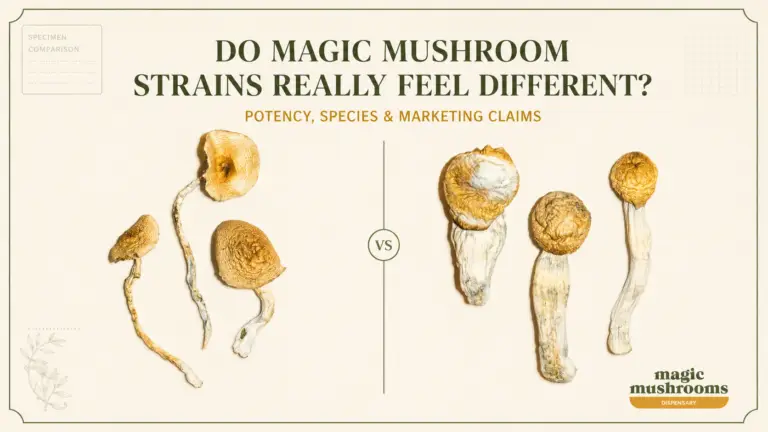
The short answer: Magic mushroom strains can differ in potency, appearance, lineage and chemical profile. What has not been established is that every strain produces its own dependable emotional tone, visual style or “personality.” A name such as Golden Teacher or Penis Envy can be useful context, but it is not a laboratory result and it cannot guarantee how one person will feel.
The most reliable differences are usually strength and product identity. The amount taken, actual batch potency, set, setting, food, format, medication and individual sensitivity can shape the experience more than a colourful strain description. Even two mushrooms from the same cultivated line may not contain identical amounts of psilocybin and related compounds.
This guide explains what species, strain and batch mean, what recent testing has found, why strain effects are easy to overstate and how to choose without treating marketing copy like a promise.
The practical rule
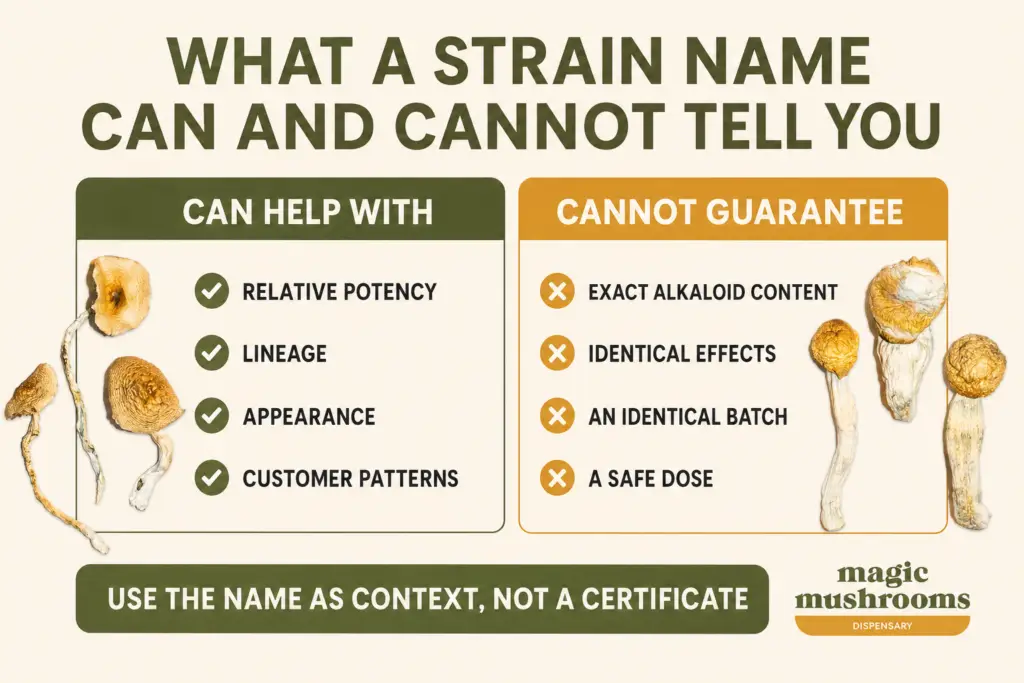
Use the strain name to compare relative potency, lineage, appearance and customer patterns. Do not use it to predict an exact dose, guaranteed effect or identical experience. When changing to an unfamiliar or higher-potency strain, treat it as a new product and review the current product guidance.
Table of contents
- Do magic mushroom strains matter?
- Species, strain and batch are not the same
- What potency research actually shows
- Why strains can seem to feel different
- Which strain claims are supported?
- Is Penis Envy really stronger?
- Do minor compounds create an entourage effect?
- Caps, stems and blue bruising
- How to choose a strain more intelligently
- How to use customer reviews
- Frequently asked questions
Do magic mushroom strains matter?
Yes, but not in the simple way strain menus often suggest. A strain name can help distinguish a cultivated lineage and its typical appearance. It may also signal a broad potency tier. That matters because using the same weight of a higher-potency product can produce a much stronger experience than expected.
The strain name becomes less dependable when it is used to promise a particular feeling. Labels such as “creative,” “social,” “spiritual,” “visual” or “body-focused” usually come from grower history, customer reports and community lore. Those patterns may be useful while shopping, but controlled human studies have not established a repeatable effect profile for each named Psilocybe cubensis strain.
Most human research uses measured synthetic psilocybin rather than named dried mushroom strains. In controlled studies, dose is a major predictor of intensity, while preparation, mood, personality and setting also matter. The pooled analysis of 409 psilocybin administrations found that dose was the strongest predictor of response and that non-drug factors helped shape pleasant and difficult reactions.
For the full catalogue view, use the Magic Mushroom Strains Guide. Its effect descriptions are best read as customer-facing tendencies, not guarantees. This article supplies the evidence framework behind those comparisons.
Species, strain and batch are not the same thing
Species
A species is a biological classification. Psilocybe cubensis is the species behind many familiar commercial names, including Golden Teacher, B+, Transkei and Penis Envy lineages. Psilocybe cyanescens and Psilocybe semilanceata are separate species, not stronger “strains” of cubensis.
Species can differ in genetics, morphology, habitat and average chemical composition. That makes a species distinction more fundamental than a retail strain name. It also means wild mushroom identification is not a shopping exercise. Health Canada warns that lookalike species can lead people to consume poisonous mushrooms by mistake. Appearance alone is not a safe identification method.
Strain, variety or cultivated lineage
In mushroom retail, “strain” is the familiar word for a cultivated line selected and circulated under a name. Mycologists may use more precise terms such as isolate, variety, cultivar or lineage depending on how the material was produced. The retail naming system is not centrally regulated, so two growers may not preserve or label a named line in exactly the same way.
That does not make every name meaningless. A stable lineage can carry recognizable growth traits and a tendency toward higher or lower alkaloid production. The name is still a starting point, not chemical proof.
Batch
A batch is the actual group of mushrooms produced, dried and packaged together. Cultivation conditions, substrate, genetics, maturity at harvest, drying, storage and time can all influence the finished product. Batch information is closer to the mushrooms in your hand than a story about where a strain supposedly originated decades ago.
What does research show about strain potency?
A 2026 study offers unusually useful evidence. Researchers grew 14 Psilocybe cubensis strains under the same controlled conditions, then measured psilocybin, psilocin, baeocystin, norbaeocystin, aeruginascin and norpsilocin.
Total tryptamine concentration varied by more than 7.8 times across the strains, from 2.62 to 20.65 milligrams per gram. Psilocybin was the dominant compound in every strain tested. This is strong evidence that cultivated lineages can differ chemically even when cultivation and analysis are standardized. Read the full 14-strain potency study.
The same study also found substantial variation between individual fruiting bodies within selected strains. The coefficient of variation for psilocybin ranged from about 13 to 23 percent. In plain language, a strain can have a real average tendency while individual mushrooms still vary around it.
That is the missing half of many strain comparisons. “Strains never matter” is too dismissive because measured chemical differences exist. “This strain always feels exactly like this” is too confident because the chemical content and human experience are not fixed.
Why one study does not create a universal ranking
The 14-strain study tested specific genetic material grown and handled under a defined protocol. It did not prove that every product sold under the same names will match those exact results. A different culture, grow, harvest or storage history can shift the outcome. A ranking is only as current and relevant as the batch behind it.
Another peer-reviewed analysis used DNA barcoding and chemical testing across Psilocybe specimens. It found misidentification problems in collections and databases, large chemical variability and time-dependent degradation. The authors concluded that mushroom names and chemical assumptions are less reliable than many people believe. See the DNA authentication and chemical analysis study.
Why can two strains seem to feel different?
Potency changes more than volume
A stronger amount does not simply turn up the same experience like a speaker. Greater exposure can change the balance of visuals, thought intensity, time distortion, emotion, body sensations and loss of ordinary control. If one strain is more potent per gram, the experience may feel qualitatively different even when potency is the main difference.
This is why copying the same gram amount across strains can be misleading. The 1 gram, 2 gram and 3.5 gram effects guide explains how intensity can change with amount, while the main dosage guide covers cautious measurement and preparation.
Set and setting are part of the experience
Set means the person’s mindset, expectations and current emotional state. Setting includes the physical and social environment. Music, lighting, company, privacy, preparation and whether the person feels safe can all influence what receives attention and how sensations are interpreted.
If someone expects a strain to be energetic, creative or deeply introspective, that description can also shape what they notice. Expectation does not mean the experience is fake. It means a report cannot separate chemistry, context and suggestion without a controlled comparison.
Format, food and timing can change the arc
Dried mushrooms, capsules, tea and edibles may not feel identical in onset or digestion. Food can delay onset for some people. Nausea or a fast come-up can colour the experience before any supposed strain personality becomes relevant. Compare the onset guide by format and food and what to eat before, during and after shrooms.
Which magic mushroom strain claims are actually supported?
| Claim | What the evidence supports | How to use it |
|---|---|---|
| Some strains are more potent | Controlled chemical testing shows large differences among cultivated cubensis lineages | Use broad potency tiers, then check current product and batch information |
| A strain has recognizable appearance and lineage | Cultivated lines can have repeatable morphological and growth traits | Useful for product identity, but appearance alone does not measure potency |
| A strain always produces one emotional tone | Customer patterns exist, but controlled human evidence for fixed strain personalities is lacking | Treat “creative,” “social” or “spiritual” as descriptive shorthand, not a promise |
| A named strain guarantees an exact percentage | Individual mushrooms and batches can vary within the same line | Do not convert a strain name into a fixed dose calculation |
| A strain is therapeutic for a condition | Clinical research studies structured treatment with measured psilocybin, not retail strain claims | Do not choose a strain as a replacement for medical care |
This does not mean customer language must be stripped from every product page. It means the wording should be honest about its source. “Customers often describe” is more accurate than “this strain will make you creative.” “Higher potency” is more useful when it is supported by current testing or consistent batch knowledge rather than repeated as folklore.
How Magic Mushrooms Dispensary uses strain descriptions
Product history and verified customer reviews help identify recurring patterns. Research and current product information carry more weight than anecdotes. No review, strain name or staff description can guarantee one customer’s exact response.
Is Penis Envy really stronger than ordinary cubensis strains?
Penis Envy and related lines are generally treated as higher-potency cubensis products, and chemical testing has found notable alkaloid profiles in Penis Envy samples. The 2026 study, for example, found the highest measured psilocin concentration among its tested strains in Penis Envy. That does not create a universal multiplier for every Penis Envy batch.
The useful conclusion is conservative: do not copy a familiar Golden Teacher amount when switching to Penis Envy. Compare the two directly in the Golden Teacher versus Penis Envy guide. It covers relative potency, experience level, price and who each product is designed for without pretending every batch is identical.
Golden Teacher is positioned as the more approachable, moderate choice in the Magic Mushrooms Dispensary catalogue. Penis Envy is positioned for experienced customers seeking higher potency. “Beginner friendly” is relative language, not a claim that Golden Teacher is risk free or predictable.
Do minor mushroom compounds create an entourage effect?
Whole mushrooms can contain psilocybin, psilocin and smaller amounts of related tryptamines such as baeocystin, norbaeocystin, aeruginascin and norpsilocin. Their ratios can differ among samples. Researchers have also identified many other compounds in the Psilocybe cubensis metabolome.
That chemical complexity is interesting, but it does not yet prove a dependable mushroom “entourage effect” that gives each strain a distinct personality. Laboratory and animal work on minor tryptamines has produced mixed findings. A 2024 pharmacology study of mushroom tryptamines found overlapping biological activity in some tests, while only psilocybin produced the study’s behavioural marker of psychedelic-like effects in rats.
Human head-to-head trials would be needed to determine whether two whole-mushroom strains with matched psilocybin exposure produce reliably different subjective effects. Until then, minor compounds are a research question, not proof that one strain guarantees laughter while another guarantees insight.
Do caps, stems or blue bruising reveal potency?
Caps versus stems
There is no dependable rule that every cap is a fixed percentage stronger than every stem. Studies have reported different cap and stem relationships, and one modern analysis of cultivated Psilocybe cubensis found no significant difference in psilocybin or psilocin between the tested tissues. The sample sizes and methods across studies vary.
Sorting a bag into caps and stems is not a reliable dosing system. A representative mixture that is measured carefully is more sensible than assuming one anatomical part has a guaranteed strength.
Blue bruising
Psilocybe mushrooms can turn blue when tissue is damaged. Research shows that injury triggers enzymatic reactions and oxidation involving psilocin-derived compounds. The depth of the colour is not a calibrated potency test. Bruising depends on damage, chemistry, oxygen and handling, so a darker mushroom does not automatically contain a known amount of psilocybin. Read the blueing chemistry study.
Size and dramatic appearance
A large fruiting body, albino colour, unusual cap or thick stem may help identify a product’s appearance, but none acts as a lab report. Visual inspection can support identity within a known supply chain. It cannot quantify the compounds in an individual mushroom.
How to choose a magic mushroom strain more intelligently
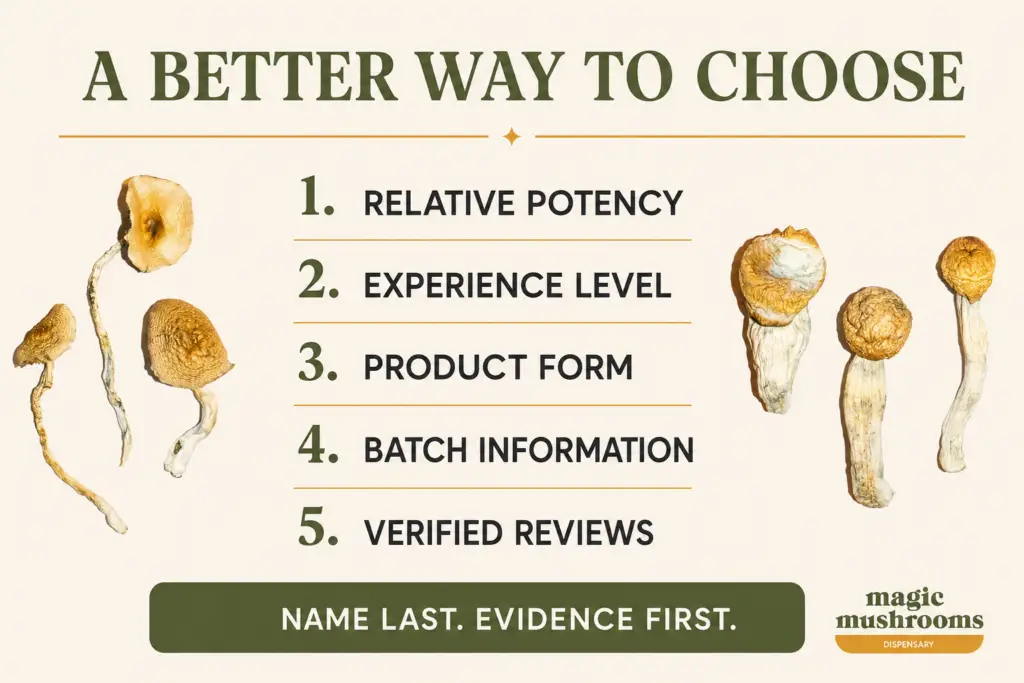
1. Begin with relative potency
Decide whether the product is positioned as moderate, high or very high potency. This is more useful than choosing “best for creativity” or “best for nature.” If the potency information is vague, treat the product as uncertain rather than filling the gap with a strain legend.
2. Match the product to experience level
A new or cautious customer does not need the strongest name on the menu. Review the first shrooms trip guide before choosing, and do not use a high-potency strain as a shortcut to a meaningful experience.
3. Choose the product form
Dried mushrooms make the strain identity visible, while capsules offer pre-measured portions and edibles use a labelled product format. The form can change convenience, label reading, digestion and onset. Compare the different forms of shrooms before focusing on a strain name.
4. Read the current product page
Use current potency positioning, quantity, recent reviews and product-specific directions. Do not rely on a forum post about a similarly named culture from another grower. Product information can change, so check the page again when returning to a strain after a long break.
5. Check storage and condition
Heat, light, moisture, oxygen and time can affect quality. A famous strain stored badly is not better than a modest strain stored well. Follow the magic mushroom storage guide and do not use mushrooms with signs of mould or spoilage.
6. Keep safety separate from branding
No strain name cancels medication interactions, mental health concerns, an unsafe setting or impaired judgment. Read the safety and mental health guide and the psilocybin and medications guide. Do not stop or change prescribed medication to use mushrooms.
How much should you trust strain reviews?
Verified reviews can reveal recurring patterns that a product description misses. They can help answer practical questions: Did customers find the batch stronger than expected? Was the dried product in good condition? Did people describe a manageable or demanding experience? Does the product match its stated category?
Reviews still have limits. Customers take different amounts in different settings, often without chemical testing. People who expect a certain effect may be more likely to notice and report it. A five-star review is evidence that one customer liked the product, not proof that the same strain will create the same experience for everyone.
Use the verified customer reviews to look for patterns, then cross-check the current product page and broader evidence. Reviews are strongest when they describe the product received and the context, not when they make medical claims.
Frequently asked questions
Do magic mushroom strains really matter?
They can matter for relative potency, appearance, lineage and product identity. They are less reliable for predicting an exact emotional or visual experience.
Do different mushroom strains feel different?
They may, especially when potency differs. Customer reports also describe recurring tendencies, but controlled human research has not established a guaranteed effect profile for each named cubensis strain.
Are all Psilocybe cubensis strains basically the same?
No. A 2026 controlled cultivation study found more than a 7.8-fold range in total tryptamines across 14 cubensis strains. It also found variation between individual mushrooms within the same strain.
What is the strongest magic mushroom strain?
No name wins every batch. Some lineages repeatedly test at the high end, but a universal ranking ignores genetics, cultivation, handling and batch variation. See the most potent strains guide as a catalogue comparison, not a lab certificate.
Is Penis Envy stronger than Golden Teacher?
Penis Envy is generally treated as the higher-potency lineage, while Golden Teacher is positioned as moderate. Do not apply one fixed multiplier to every batch or copy the same amount when switching.
Is Golden Teacher the best strain for beginners?
Golden Teacher is a popular, moderate catalogue choice for new and cautious customers. “Beginner friendly” means more approachable relative to stronger options. It does not mean predictable or risk free.
Are mushroom caps stronger than stems?
Not by a dependable universal ratio. Research has reported varying results, and individual mushrooms vary too. Do not use caps versus stems as a substitute for careful measurement and product guidance.
Does more blue bruising mean stronger mushrooms?
No reliable colour scale converts bruising into potency. Blueing is an injury-triggered chemical reaction. Its intensity depends on more than the original alkaloid concentration.
Can mushrooms from the same batch have different potency?
Yes. Recent controlled testing found measurable variation among individual fruiting bodies from the same named strain. Grinding and homogenizing a known batch may reduce uneven distribution, but it does not reveal the actual concentration.
How should I choose between strains?
Compare relative potency, experience level, current product information, format, storage and verified reviews. Put specific effect promises near the bottom of the decision, not the top.
A strain name is a clue, not destiny
The honest answer is more useful than either extreme. Magic mushroom strains are not identical, and chemistry can vary substantially across cultivated lines. At the same time, a name cannot guarantee exact potency or a scripted emotional journey.
Start with relative strength, current product information and your actual experience level. Treat customer descriptions as patterns and marketing language as shorthand. Then account for the variables that follow you into every experience: amount, mindset, setting, format, food, medication and individual sensitivity.
To compare real options, browse the dried magic mushrooms category, review Golden Teacher and Penis Envy, or explore all products. The Magic Mushrooms Dispensary homepage and education library provide the wider path from product comparison to preparation and safety.