
The short answer: You may be able to sleep after taking shrooms, but falling asleep during the active effects is often difficult. Psilocybin can leave the mind alert, thoughts active, emotions close to the surface and ordinary sensations unusually noticeable. For many people, sleep becomes more realistic only after the strongest effects have faded. That can be several hours after swallowing mushrooms, and a late start can push sleep well past the usual bedtime.
There is no universal hour when everyone is ready to sleep. The amount taken, product strength, format, food, caffeine, other substances, anxiety, setting and personal sleep pattern can all change the night. Feeling tired also does not prove that the psychedelic effects are over, and being able to close your eyes does not guarantee restorative sleep.
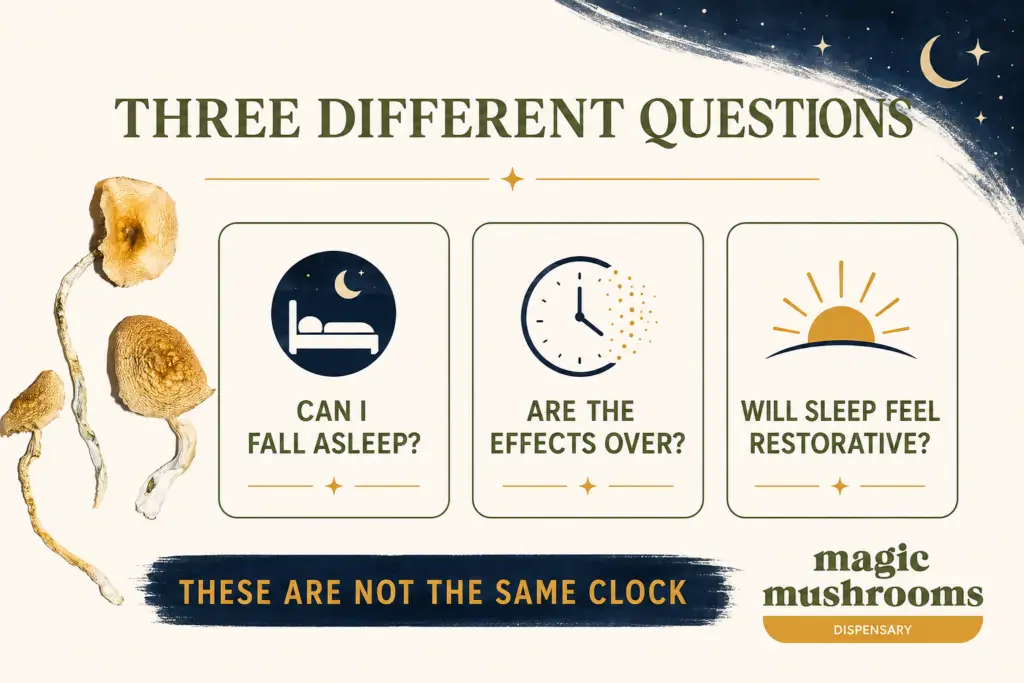
This guide separates three questions people often combine: Can I fall asleep? Are the active effects over? Will the sleep feel normal? It also explains the research, practical timing and when to get help.
If someone seems to be asleep after taking shrooms
- Check that the person can be woken and is breathing normally. Unconsciousness, trouble breathing or a seizure is not ordinary sleep. Call 911.
- Do not leave an impaired person alone while they are actively vomiting. If they cannot stay awake, have trouble breathing, have a seizure or cannot be roused, call 911.
- Call a poison centre when the product, mushroom or mixture is uncertain. In most of Canada, call 1-844-764-7669. In Quebec, call 1-800-463-5060. In Nunavut, contact the local health centre.
- Do not drive. A person who is still altered, dizzy, confused or severely sleep deprived should not drive or do safety-sensitive work.
Table of contents
- Can you actually sleep on shrooms?
- Three different clocks
- When might sleep become possible?
- Why can shrooms keep you awake?
- What does the sleep research show?
- Daytime versus evening timing
- What to do if you cannot sleep
- What not to use as a sleep fix
- The next morning and next night
- Should you microdose at night?
- When to get help
- Planning a future experience around sleep
- Frequently asked questions
Can you actually sleep on shrooms?
Some people can fall asleep while low-level effects are still present. Others remain awake until the experience has nearly or completely ended. Sleep during the peak is less likely because perception, attention, emotion and the sense of time may all be altered. Closing the eyes can also make imagery or thoughts feel more prominent rather than quieter.
Do not treat one person’s timing as a rule. “I always sleep after six hours” is a personal report, not a safety guarantee. Dried mushrooms can vary in strength, and different formats can have different onset patterns.
If you are trying to understand where you are in the experience, use the complete guide to how long shrooms last and the shroom onset guide. A clock can provide context, but your current coordination, judgment, perception and ability to communicate matter more than a predicted finish time.
Falling asleep, ending the trip and feeling rested are three different clocks
The word “sleep” hides several separate questions:
- Can I fall asleep? This is about sleep onset. You might feel physically tired while your thoughts and senses remain active.
- Are the effects over? A person may doze near the tail end and still wake feeling altered. Sleep is not proof of sobriety.
- Will the sleep feel restorative? A short, late or fragmented night may leave someone tired even if they technically slept.
This distinction prevents two mistakes: assuming that lying in bed means the trip has ended, and expecting one night’s sleep to erase every after-effect. The body may need ordinary food, water, daylight and another normal night.
How long after taking shrooms can you sleep?
Health Canada says effects may appear within 15 to 45 minutes and usually last four to six hours. Real-world timing can be wider. Food, format, dose, product strength and individual digestion can move both the beginning and the tail. A person may also notice a lighter afterglow or residual stimulation after the obvious visuals have faded.
That is why “four to six hours” should describe a common acute-effects window, not a bedtime appointment. Someone who takes mushrooms at 8:00 p.m. could still be clearly affected after midnight, then need more time to wind down. Someone who starts earlier may reach bedtime after the main effects have passed, but no schedule guarantees easy sleep.
Clear the rest of the day and the following morning. Do not schedule driving, childcare, an early work shift or anything that depends on sharp judgment. If sleep arrives late, ordinary sleep loss may explain much of the next-day fatigue.
Can you sleep during the peak?
It is possible, but many people find it difficult. During the peak, internal imagery, sound, body sensations and thoughts can remain vivid with the eyes closed. Trying to force sleep may create frustration, and repeatedly checking the time can make the night feel even longer.
If someone suddenly becomes unresponsive, has abnormal breathing, turns blue or grey, has a seizure or cannot be woken, do not assume they finally fell asleep. Call 911. Ordinary sleep and loss of consciousness are not interchangeable.
Why can shrooms keep you awake?
The mind may still be highly engaged
Psilocybin can make ordinary thoughts, memories, emotions and sensory details feel unusually important. Even a calm experience can be mentally absorbing. The person may feel exhausted and curious at the same time, which is not an ideal recipe for falling asleep.
Anxiety can create a second wind
Worrying about whether the trip should be over can increase alertness. “I have to sleep now” often makes sleep harder. A trusted sober person can calmly confirm the time, surroundings and that the experience is moving forward.
Physical discomfort can interrupt settling down
Nausea, stomach tension, temperature changes, muscle tightness, a headache or an uncomfortable room can keep someone awake. Adjust the room, loosen restrictive clothing and take normal sips of water. The guide to shroom nausea covers stomach symptoms in more detail.
Timing and other substances matter
A late dose may overlap with the body’s normal sleep window. Caffeine, energy drinks, cannabis, alcohol, stimulants and medications can further complicate the experience. Health Canada warns that combining magic mushrooms with substances such as cannabis, amphetamines and alcohol raises the risk of serious side effects and adverse events.
If medication is involved, do not stop, skip or change a prescription to make room for psilocybin. Read the psilocybin and medications guide and ask a physician or pharmacist about the actual medication and health history.
What does research say about psilocybin and sleep?
The honest answer is that direct human evidence is small. One randomized, double-blind study compared psilocybin with placebo in 20 healthy adults. The dose was given during the day, and researchers measured sleep that night with laboratory equipment.
Psilocybin delayed the start of rapid eye movement sleep, called REM sleep, and showed a statistical trend toward less total REM time. It did not produce a significant difference in how long participants took to fall asleep, total sleep time, sleep efficiency, number of sleep cycles or the proportion of time spent in the measured sleep stages. Slow-wave activity was lower in the first sleep cycle, contrary to the researchers’ original prediction. You can read the full daytime psilocybin sleep study.
Those results do not prove that late-night mushrooms improve sleep, ruin sleep or create a therapeutic “reset.” The small study involved screened volunteers and controlled daytime administration, not dried mushrooms at bedtime. It did not establish a later REM rebound.
An animal study found delayed REM onset and less stable non-REM sleep for about three hours after mice received psilocin, but mice cannot establish the human experience. A separate LSD microdosing study found more sleep the following night. That study involved LSD, not psilocybin, so it does not prove that psilocybin microdoses improve sleep.
Bottom line: Human psilocybin sleep research is too limited for confident promises. The available study suggests that daytime psilocybin can alter aspects of sleep architecture that night, even when ordinary measures such as total sleep time and sleep efficiency do not significantly change.
Daytime versus evening: what changes?
| Timing | Potential practical advantage | Sleep concern |
|---|---|---|
| Earlier daytime | More time for acute effects and the comedown before the usual bedtime | Sleep may still be delayed or feel different, so the evening and next morning still need to be clear |
| Late afternoon or evening | May fit a person’s free time | The strongest effects or mental activity may overlap with normal bedtime |
| Late night | No sleep advantage has been established | Greater chance of remaining awake until morning and starting the next day sleep deprived |
This is harm-reduction planning, not encouragement to take psilocybin. Earlier timing reduces one avoidable sleep conflict, but it does not remove psychological, physical, legal or interaction risks. Review the complete safety and mental health information first.
What to do if you cannot sleep after shrooms
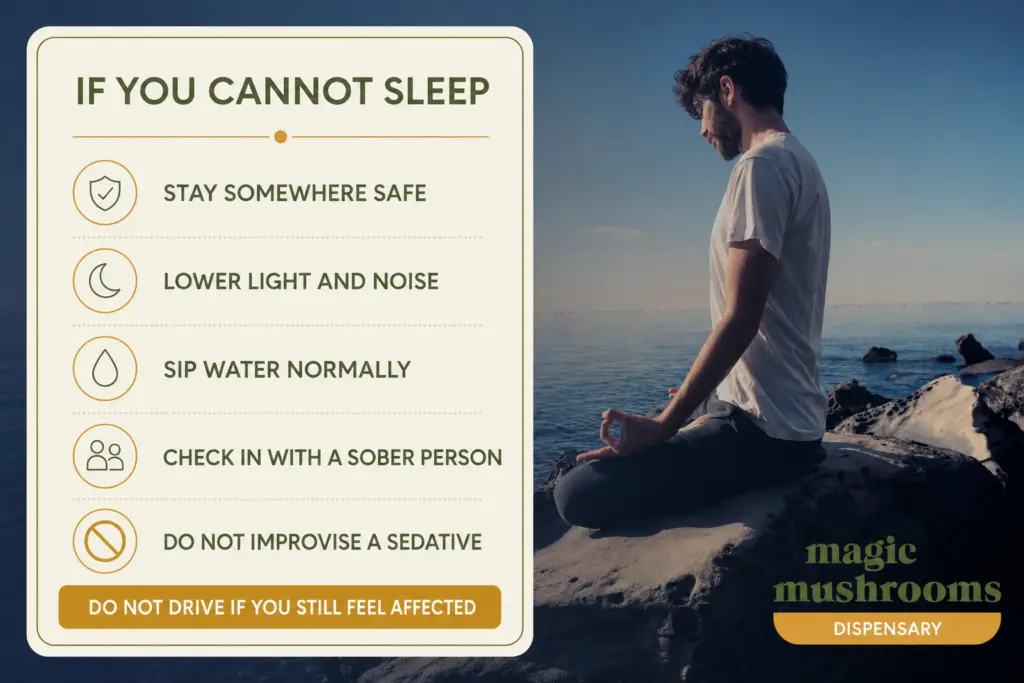
- Stop fighting the clock. The immediate goal is safe, quiet rest, not forcing unconsciousness by a certain minute.
- Stay somewhere familiar. Do not go for a drive or wander outside alone because the bedroom feels frustrating.
- Lower light and noise. Put away intense videos, busy music and constant phone scrolling. Soft light and a comfortable temperature may help.
- Check in with a sober person. A calm voice can help confirm that time is passing and spot symptoms that should not be managed alone.
- Sip water normally. Small, ordinary amounts are enough unless a health professional advises otherwise. Do not try to flush the substance with litres of water.
- Use simple grounding. Notice the support of the bed or chair, name a few familiar objects and let the exhale become slightly longer than the inhale. Stop if breath counting increases anxiety.
- Reassess safety. Severe confusion, chest pain, trouble breathing, seizure, loss of consciousness, dangerous agitation or an unknown mushroom needs help, not a darker room.
If nausea is present, stay upright or rest on your side rather than flat on your back. Do not leave someone alone if they are impaired and actively vomiting. Repeated vomiting, inability to keep fluids down, reduced responsiveness or abnormal breathing requires professional advice or emergency help depending on severity.
What should you not take to make yourself sleep?
Do not improvise a chemical “trip killer” or stack substances until something causes sedation. Alcohol, cannabis, prescription sedatives and over-the-counter sleep products can add impairment, vomiting, confusion, breathing risk or unpredictable interactions. Feeling sedated is not the same as being medically safe.
Do not take another person’s benzodiazepine or sleeping pill. Do not take extra doses of your own medication outside the prescribed instructions. Do not assume an antihistamine, melatonin or herbal product is automatically appropriate because it is sold without a prescription. A pharmacist or physician can consider the exact product, amount, timing, health conditions and other medications.
If substances have already been mixed, be honest about what and how much was taken. Canada’s poison centres are staffed around the clock by nurses and pharmacists trained in toxicology. Call 1-844-POISON-X in most provinces and territories. Quebec uses 1-800-463-5060, and Nunavut directs residents to the local health centre. Call 911 if the person is unconscious, not breathing or having a seizure.
What if you sleep badly and feel tired the next day?
A short night can bring fatigue, headache, irritability, low appetite, poor concentration and emotional sensitivity. Some people also describe a positive afterglow while their body still feels tired. These experiences can coexist.
Keep the next day simple. Drink normally, eat familiar food when appetite returns, lower demands and avoid driving until fully rested, clear and unimpaired. The full shroom hangover and next-day recovery guide separates common improving symptoms from signs that need professional attention.
If sleep returns the next night and symptoms are improving, ordinary recovery may be all that is needed. If you remain unable to sleep or develop racing thoughts, grand plans, risky behaviour or little sense that you need sleep, contact a health professional promptly.
Should you microdose at night?
There is not enough psilocybin-specific sleep evidence to call nighttime microdosing a sleep strategy. A microdose is intended to be sub-perceptual or very lightly noticeable, but products vary and some people report alertness, restlessness, stomach discomfort or noticeable effects. A dose that disrupts concentration or sleep is not functioning as a neutral bedtime routine.
Do not make bedtime the first test of an unfamiliar product. Do not increase the amount because a small dose did not feel relaxing. If a microdose repeatedly interferes with sleep, stop experimenting and discuss persistent insomnia with a qualified health professional. The complete microdosing guide explains the basic concept, while the Fadiman and Stamets schedule comparison explains why rest days and tracking matter more than chasing a nightly sensation.
When does sleeplessness need medical help?
Get urgent help for chest pain, trouble breathing, seizure, loss of consciousness, severe or worsening confusion, dangerous agitation, violent behaviour, suicidal intent, a serious injury or an unusually severe headache with neurological symptoms. Call 911 when danger is immediate. Call or text 988 anywhere in Canada for suicide crisis support when immediate emergency response is not required.
Call a poison centre promptly if wild or unidentified mushrooms were eaten, the label is missing, the product may contain something unexpected or multiple substances were involved. Keep the remaining mushroom, package or label if it can be done safely. Identification and accurate timing can matter.
Contact a physician or mental health professional if insomnia continues into another night, anxiety or perceptual changes remain significant, symptoms return after improving or you are unable to manage normal responsibilities. Seek prompt assessment for possible mania signs such as a markedly reduced need for sleep, racing thoughts, unusually rapid speech, grandiosity or risky behaviour, especially with a personal or family history of bipolar disorder or psychosis.
How to plan a future experience around sleep
If an adult has already decided to use psilocybin, a few practical choices can reduce avoidable sleep problems:
- Start earlier. Leave the rest of the day and the next morning free.
- Use a familiar setting. Arrange a trusted sober sitter, especially for a first experience.
- Know what you are taking. Keep the label and avoid unidentified wild mushrooms.
- Measure rather than guess. Weight does not guarantee potency, but it is better than an unmeasured handful.
- Do not mix substances. Alcohol, cannabis, stimulants and sedatives can make both the experience and sleep harder to interpret.
- Plan ordinary aftercare. Have water, familiar food, comfortable clothing and a quiet room ready before starting.
- Protect the next morning. Do not promise yourself that a few hours of sleep will make early driving safe.
First-time readers should begin with the first shrooms trip guide, then review what to eat before, during and after shrooms. These pages cover preparation that is easy to overlook when attention is fixed only on dose.
If you later choose to browse, Magic Mushrooms Dispensary organizes clearly described options in the dried mushrooms category and capsules category. You can also review the Golden Teacher product page, explore the complete shop or return to the education library. These are future planning links, not solutions for someone who is currently unable to sleep.
Frequently asked questions
Can you sleep on shrooms?
Yes, some people can, especially as the active effects fade. Many find sleep difficult during the peak or strong portion of the experience. Falling asleep does not prove that all impairment has ended.
How long after shrooms can you sleep?
There is no fixed time. Health Canada says effects usually last four to six hours, but onset, intensity and the tail vary. Sleep may not come until later, particularly after an evening or late-night start.
Do shrooms keep you awake?
They can. Active thoughts, altered perception, anxiety, nausea, body sensations and late timing may all delay sleep. Other substances, including caffeine, cannabis or stimulants, can complicate the night.
Can you take shrooms at night?
A late start makes it more likely that active effects will overlap with normal bedtime and that the next day will begin after too little sleep. Earlier timing does not remove the broader risks, but it leaves more room before bedtime.
Do shrooms affect REM sleep?
In one small study of 20 healthy adults, daytime psilocybin delayed REM onset that night and showed a trend toward less REM time. The study did not prove a later REM rebound or a deep-sleep reset.
Why am I tired after shrooms?
The experience may have lasted for hours and delayed or fragmented sleep. Emotional intensity, physical activity, missed food, nausea or another substance may add to fatigue. Rest and monitor whether the symptoms improve.
Can I take melatonin after shrooms?
Do not assume a sleep product is right for every situation. Ask a pharmacist or physician who can consider the exact mushroom product, amount, other substances, medications and health conditions. Do not stack products in an attempt to force sleep.
Can alcohol or cannabis help me sleep after shrooms?
They are not reliable sleep fixes and can add impairment, nausea, anxiety, confusion and other adverse effects. Health Canada warns that mixing magic mushrooms with alcohol, cannabis and other substances raises risk.
Is it dangerous to sleep after vomiting?
A fully alert person whose nausea has settled may rest, preferably on their side. An impaired person who is actively vomiting should not be left alone. Call 911 if the person cannot be woken, has abnormal breathing or has a seizure.
What if I still cannot sleep the next night?
Contact a health professional, especially if insomnia is accompanied by racing thoughts, unusual energy, risky behaviour, severe anxiety, confusion or persistent perceptual changes. Continued sleeplessness should not be treated by taking more substances.
The best sleep strategy begins before the trip
Shrooms are not a dependable sleep aid. The active experience can overlap with bedtime, and the limited human research does not support promises of a sleep reset. The safest practical approach is to start earlier, protect the full night and next morning, avoid mixing substances and accept quiet rest if sleep does not arrive immediately.
If someone appears to be sleeping, make sure they can be woken and are breathing normally. If the night is merely long, lower stimulation and let time pass. If symptoms are severe or worsening, call for help.