
The short answer: A “shroom hangover” is not a medical diagnosis, but some people do feel tired, headachy, emotionally sensitive, foggy or low in appetite the day after taking psilocybin mushrooms. Others wake up calm, reflective or unusually open, an experience often called an afterglow. Both can happen, and a positive mood does not rule out physical fatigue.
Mild symptoms that steadily improve with food, normal hydration and rest often settle within the day. Severe, worsening or persistent symptoms deserve professional attention. Chest pain, a seizure, trouble breathing, loss of consciousness, dangerous confusion, extreme agitation or thoughts of suicide require urgent help.
This guide explains common next-day effects, what may contribute to them, how to recover sensibly and when “sleep it off” is the wrong advice. It does not assume every uncomfortable morning is dehydration, serotonin depletion or a meaningful breakthrough.
If you feel unwell right now
- Immediate danger: Call 911 or go to the nearest emergency department.
- Possible poisoning or unknown mushroom: Call Canada’s poison centres at 1-844-764-7669 in most provinces and territories. In Quebec, call 1-800-463-5060. In Nunavut, contact your local health centre.
- Suicidal thoughts or concern about someone else: Call or text 988 anywhere in Canada. If danger is immediate, call 911.
- Do not drive: If you still feel altered, foggy, dizzy, exhausted or emotionally unstable, do not drive or do safety-sensitive work.
Table of contents
- What is a shroom hangover?
- Common next-day effects
- Why might you feel off the day after shrooms?
- Why do shrooms sometimes cause a headache?
- Normal, monitor or seek help?
- A practical recovery plan
- What not to do
- Afterglow and integration
- How to reduce avoidable next-day problems
- Frequently asked questions
What is a shroom hangover?
People use “shroom hangover” as shorthand for feeling physically or mentally off after the main psychedelic effects have ended. The phrase is useful for search, but it can be misleading. An alcohol hangover has its own mixture of causes. A next-day response to psilocybin may involve a direct adverse effect, lost sleep, too little food, vomiting, emotional strain, another substance or several factors at once.
A comedown is the gradual decline of noticeable effects near the end of the experience. Next-day effects begin after that main experience has largely passed. An afterglow describes a positive residual state, such as calm, connection, clarity or emotional openness. These are not three rigid biological stages. Someone can feel peaceful and exhausted at the same time.
If you are unsure whether the main experience should already be over, compare your timing with the complete shroom duration and afterglow guide and the four phases of a shroom trip.
What can the day after shrooms feel like?
Clinical studies and personal reports describe a broad range. Commonly discussed temporary experiences include:
- Fatigue or low energy: A long, emotionally intense experience can be tiring, especially if it ran late.
- Headache: Delayed headache is a documented adverse effect of psilocybin, not merely an internet myth.
- Difficulty concentrating: Some people describe mental fog, slower thinking or reduced attention.
- Lower appetite or mild stomach discomfort: Nausea, vomiting or eating very little during the previous day can carry into the morning.
- Sleepiness or poor sleep: The body may be tired even if falling asleep was difficult after the trip.
- Emotional sensitivity: A person may feel tender, quiet, irritable, unsettled or more easily moved.
- Positive afterglow: Calm, gratitude, connection or reflective interest may remain after acute effects fade.
Symptoms do not have to fit one neat label. A mild headache and afterglow can coexist. So can fatigue and a good mood. The useful questions are whether you are safe, whether the symptoms are improving and whether anything falls outside the expected mild range.
Why might you feel off the day after shrooms?
Psilocybin itself can cause adverse effects
A 2024 systematic review and meta-analysis of six randomized clinical trials involving 528 participants found higher risks of headache, nausea, anxiety, dizziness and elevated blood pressure with therapeutic psilocybin doses. In those controlled studies, acute adverse effects generally resolved within 48 hours.
That evidence comes from screened participants receiving measured psilocybin in supervised research. It cannot guarantee the same timeline for an unknown mushroom product, a mixed-substance experience or a person with a different health history.
Sleep loss can do much of the damage
A trip that starts in the evening may keep someone awake well beyond their usual bedtime. Even when strong effects have faded, the mind may still feel alert or emotionally active. A short or fragmented night can produce headache, fatigue, irritability, poor concentration and appetite changes on its own.
Food and fluid intake may have been unusual
Some people intentionally eat very little before shrooms, lose interest in food during the experience or vomit. Others forget to drink for several hours. That can leave them hungry, thirsty or depleted by morning. Dehydration is possible, especially with vomiting, sweating or heat, but it is not a proven universal explanation for every shroom headache.
The practical food guide explains what to eat before, during and after shrooms without treating fasting as mandatory. For persistent stomach symptoms, see why shrooms can cause nausea.
The experience may have been physically or emotionally intense
Hours of muscle tension, crying, laughing, walking, dancing or holding one position can leave the body sore. A frightening or emotionally difficult trip can also leave someone feeling raw after the fear has passed. That does not prove damage, and it does not mean every difficult feeling contains a hidden lesson. It means the person may need rest, support and time before interpreting what happened.
Alcohol, cannabis or other substances complicate the picture
When other substances were involved, it becomes harder to identify the cause. Alcohol can contribute its own headache, nausea, dehydration and sleep disruption. Cannabis may increase anxiety or perceptual changes in some people. Prescription and non-prescription drugs can add interaction concerns. Do not assume every symptom came from psilocybin alone.
Do not stop a prescription because of a psychedelic experience. Review the psilocybin and medications guide and contact a pharmacist, physician or poison centre for advice about the actual substances involved.
“Serotonin depletion” is not an established explanation
Psilocin acts primarily at serotonin receptors, especially the 5-HT2A receptor. That does not mean a difficult morning proves your brain “ran out” of serotonin. Current evidence does not support using universal serotonin depletion as the explanation for a shroom hangover. Avoid supplement stacks marketed to “restore” a neurotransmitter balance that was never measured.
Why do shrooms sometimes cause a headache the next day?
Headache deserves its own section because it is one of the better documented delayed effects. A small double-blind study gave 18 healthy volunteers a range of measured psilocybin doses. Headache incidence, duration and severity increased with dose. The headaches began later, were not severe or disabling in that study, and lasted no more than a day. Read the published headache study.
The study discussed possible mechanisms, but it did not establish one universal cause. Sleep loss, muscle tension, vomiting, missed meals, dehydration, caffeine withdrawal and an existing migraine condition can also matter. More than one explanation may apply.
A familiar mild headache that improves is different from a sudden or unusually severe headache, one following a fall or head injury, or one accompanied by weakness, trouble speaking, fainting, fever, stiff neck, severe confusion or vision loss. Those combinations need urgent medical assessment.
Next-day symptoms: normal, monitor or seek help?
| Level | Examples | What to do |
|---|---|---|
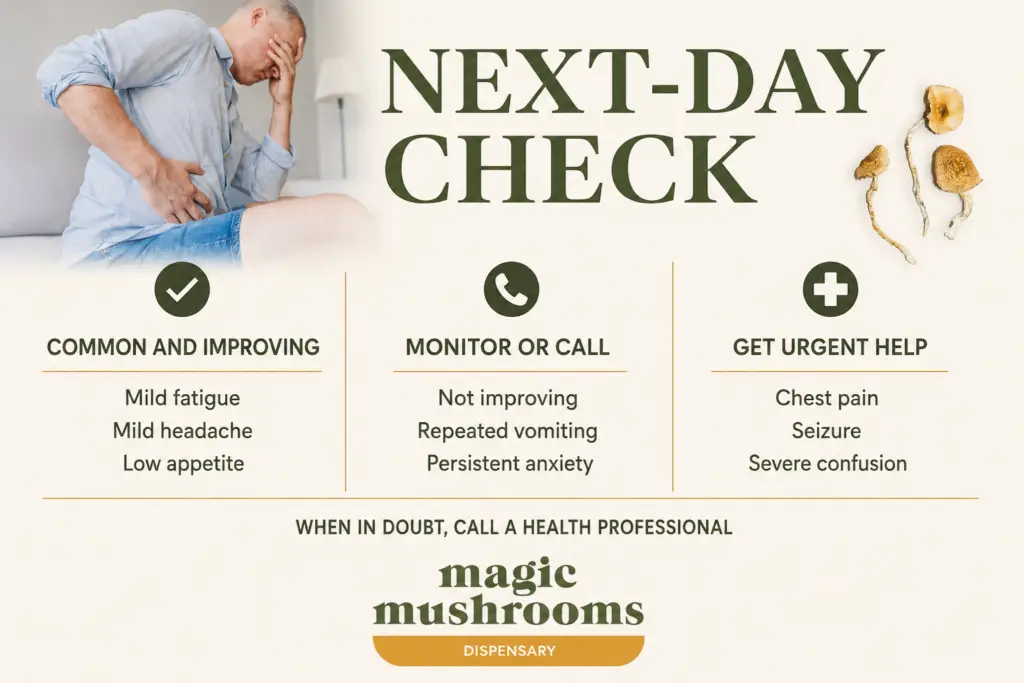
| Common and improving | Mild fatigue, familiar mild headache, lower appetite, emotional sensitivity or a quiet reflective mood that steadily eases | Rest, drink normally, eat something familiar, lower stimulation and check again later |
| Monitor and call for advice | Symptoms that are not improving, repeated vomiting, inability to keep fluids down, persistent insomnia, significant anxiety, returning visual changes or unusual confusion | Contact a physician, pharmacist, local health service or poison centre. Do not take more substances to correct the feeling |
| Urgent help | Chest pain, trouble breathing, seizure, loss of consciousness, severe agitation, dangerous behaviour, severe confusion, sudden worst headache, one-sided weakness or suicidal intent | Call 911 or go to an emergency department. Call or text 988 for suicide crisis support when danger is not immediate |
Important: If foraged or unidentified mushrooms were consumed, do not use a shroom-hangover checklist to rule out poisoning. Call a poison centre promptly and keep any remaining mushroom or packaging for identification.
A practical recovery plan for the day after shrooms
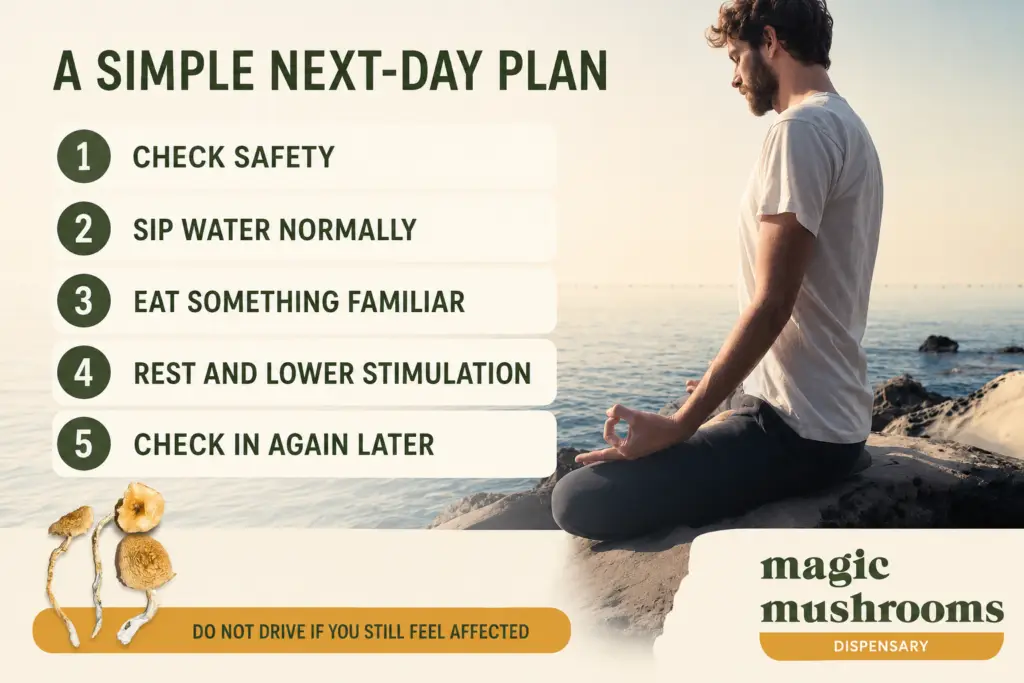
1. Check safety before comfort
Confirm what was taken, approximately when, whether alcohol, cannabis, medication or another drug was involved, and whether anyone fell or was injured. Ask whether symptoms are mild and improving or severe and worsening. When details are uncertain, call a poison centre or health professional rather than guessing.
2. Drink normally, not aggressively
Take small, regular sips of water. If vomiting or sweating occurred, a familiar oral rehydration drink may be reasonable, but water is not an antidote to psilocybin. Forcing large amounts quickly can be dangerous. Repeated vomiting or inability to keep fluid down needs medical advice.
3. Eat something simple and familiar
When appetite returns, try food you already tolerate. Toast, rice, bananas, oatmeal, soup, crackers, eggs or another simple meal may be easier than greasy or highly spiced food. There is no required “detox” menu. The goal is ordinary nourishment, not cleansing the body on a deadline.
4. Protect the day
Keep demands low. Rest in a familiar place, reduce noise and bright screens, and postpone strenuous exercise if you feel weak, dizzy or sleep deprived. Do not drive because the clock says the trip should be over. Drive only when fully rested, clear and unimpaired.
5. Check in with another person
Tell a trusted person how you feel, especially after a difficult night. A short check-in can catch worsening confusion or distress that is harder to judge alone. If the emotional response feels intense, contact a qualified mental health professional rather than relying only on an online forum.
6. Reassess later
Note whether food, fluids and rest are followed by steady improvement. If symptoms remain significant, return after initially improving or continue beyond the expected short period, contact a health professional. Controlled-trial averages are not a personal deadline.
What not to do during shroom recovery
- Do not take more shrooms: Redosing does not diagnose or repair next-day symptoms.
- Do not use alcohol or cannabis as a reset: They can worsen nausea, anxiety, sleep and judgment.
- Do not overuse caffeine or energy drinks: Stimulation can aggravate anxiety, palpitations and a headache.
- Do not force litres of water: Normal hydration is safer than trying to flush the body rapidly.
- Do not copy a supplement stack: A forum recipe cannot account for medication, health conditions or what was actually taken.
- Do not make major decisions immediately: Write an idea down, sleep and revisit it when ordinary judgment has returned.
- Do not hide important details from medical staff: Accurate information helps them assess interactions, injury and poisoning.
What is a psilocybin afterglow?
Afterglow is a non-medical term for positive feelings that remain after acute psychedelic effects have faded. People may describe more calm, emotional openness, gratitude, connection or interest in reflection. It is not guaranteed, and it should not be treated as proof that the experience cured a condition.
A 2019 naturalistic study assessed people attending a psilocybin retreat before, the morning after and seven days later. The researchers found changes in some measures of creative thinking, empathy and subjective wellbeing. Because it was a retreat study without a placebo control and participation dropped by the seven-day follow-up, it shows an association rather than proof that psilocybin caused every change. See the study summary on PubMed.
Integration does not require an instant interpretation
Integration means reflecting on the experience and deciding, gradually, whether anything deserves a practical place in daily life. It does not require declaring every image prophetic or every difficult moment therapeutic.
The Johns Hopkins safety guidelines for hallucinogen research recommend post-session contact, often the next day, to assess psychological stability and discuss thoughts and feelings. That is a useful principle outside research too: check safety first, then reflect with someone trustworthy.
The first shrooms trip guide includes morning-after journal prompts and 24-hour and 72-hour check-ins. Keep the first notes factual. What happened? What did you feel? What remains confusing? What small, safe action still makes sense after sleep?
How to reduce avoidable next-day problems
No routine can guarantee an easy morning, but preparation can remove several avoidable problems:
- Start earlier: Leave enough time for the experience and comedown before your normal sleep window.
- Protect the next day: Avoid early driving, childcare, work deadlines or safety-sensitive responsibilities.
- Eat thoughtfully: Do not turn fasting into a contest. Plan a light meal beforehand and familiar food for afterward.
- Measure rather than guess: Grams measure weight, not guaranteed potency, but an actual measurement is still more useful than an unmeasured handful.
- Avoid mixing substances: Alcohol, cannabis and other drugs make the experience and next morning harder to interpret.
- Use a safe setting and sober sitter: Good support reduces avoidable injury and helps if a difficult experience continues.
- Know the product: Keep the label or packaging and avoid unidentified wild mushrooms.
Review how different dried mushroom amounts may change intensity and the complete Magic Mushrooms Dispensary safety and mental health guide before considering another experience.
If you later decide to browse, compare clearly labelled options in the dried mushrooms category or capsules category. The shop is for a future, informed decision, not a next-day remedy. Magic Mushrooms Dispensary also maintains a growing education library covering preparation, effects and safer use.
Frequently asked questions
Can shrooms cause a hangover?
They can be followed by temporary fatigue, headache, poor concentration, appetite changes, emotional sensitivity or sleep disruption. “Shroom hangover” is an informal label, not a diagnosis, and it should not be assumed to work like an alcohol hangover.
How long does a shroom hangover last?
Mild next-day effects often improve during the day. In a meta-analysis of supervised therapeutic trials, acute adverse effects generally resolved within 48 hours. Persistent, worsening or severe symptoms should be assessed rather than forced into an average timeline.
Why am I so tired the day after shrooms?
The experience may have lasted for hours and interrupted normal sleep. Emotional intensity, physical activity, missed food, vomiting or another substance may add to the fatigue. Rest and monitor whether energy steadily returns.
Is a headache the day after shrooms normal?
A delayed, temporary headache is a documented psilocybin adverse effect. A mild familiar headache that improves is different from a sudden severe headache, one after an injury or one accompanied by weakness, fainting, confusion or vision loss. Seek urgent assessment for those warning signs.
Do shrooms dehydrate you?
Dehydration can occur if someone drinks too little, vomits, sweats heavily or spends time in heat. It is not established as the cause of every next-day symptom. Drink normally and do not force excessive water as a detox method.
Is brain fog after mushrooms expected?
Some people report temporary difficulty concentrating, especially after poor sleep or an intense experience. Brain fog that is severe, worsening, accompanied by confusion or not improving deserves professional advice.
What should I eat after shrooms?
Choose a familiar food you normally tolerate. Simple carbohydrates, soup, eggs, oatmeal or another ordinary meal may be easier if appetite is low. There is no required detox food.
Can I take pain medication for a shroom headache?
That depends on your health, other medications, allergies, vomiting, alcohol use and the product involved. Ask a pharmacist or physician about the exact situation instead of assuming an over-the-counter drug is appropriate.
What if I still feel high the next day?
Do not drive or work in a safety-sensitive role. Continued strong perceptual changes, marked confusion, severe anxiety or symptoms returning after they had stopped warrant medical advice. Call a poison centre when the product or mushroom identity is uncertain.
Is feeling emotional after shrooms a bad sign?
Mild emotional openness or sensitivity can occur. Intense distress, inability to function, paranoia, mania, suicidal thoughts or a worsening mental state needs professional support. Call or text 988 in Canada for suicide crisis help, and call 911 for immediate danger.
Recovery is not a race
The useful response to a shroom hangover is not a miracle supplement or a confident story about depleted serotonin. It is a calm safety check, normal hydration, familiar food, protected rest and honest reassessment.
Most mild next-day effects improve, but “usually” should never override what is actually happening. Call for advice when something is not improving. Seek urgent help when symptoms are severe, dangerous or outside the expected range. Once safety and sleep are handled, reflection can wait until the mind and body are ready.