
The short answer: Psilocybin is converted to psilocin quickly, and psilocin has an elimination half-life of roughly 1.5 to 4 hours in published human research. Most routine workplace drug panels do not include psilocybin or psilocin. A laboratory can still test for them when a targeted test is specifically ordered, especially soon after use.
That does not mean anyone can promise when a test will be negative. The specimen, laboratory method, detection limit, amount used, timing and individual metabolism all matter. A standard panel that never looks for psilocin is different from a targeted forensic test designed to find a trace.
This guide explains how long shrooms stay in your system, what urine, blood, saliva and hair tests can actually show, and why the duration of a trip is not the same as a detection window. It provides factual education, not instructions for evading a workplace, legal, medical or court-ordered test.
Drug testing at a glance
- Routine panels: Psilocybin is usually not included, but the only reliable answer comes from the actual panel ordered.
- Targeted urine testing: Possible, with the best chance of detection relatively soon after use. Published consumer windows are estimates, not guarantees.
- Targeted blood testing: Used for recent exposure and some forensic investigations. Psilocin concentrations decline quickly.
- Hair testing: Technically possible with specialized equipment, but uncommon and supported by limited psilocybin-specific research.
- Driving: Never use a detection estimate to decide when to drive. Canadian law sets the prohibited blood concentration for psilocybin and psilocin at any detectable level within two hours of driving.
Table of contents
- Four different clocks people confuse
- How the body processes psilocybin
- Drug test detection reference table
- Do standard drug tests look for shrooms?
- Urine testing
- Blood testing
- Saliva testing
- Hair and nail testing
- What changes a detection window?
- Can you clear shrooms faster?
- Workplace testing and driving in Canada
- Frequently asked questions
Four different clocks people confuse
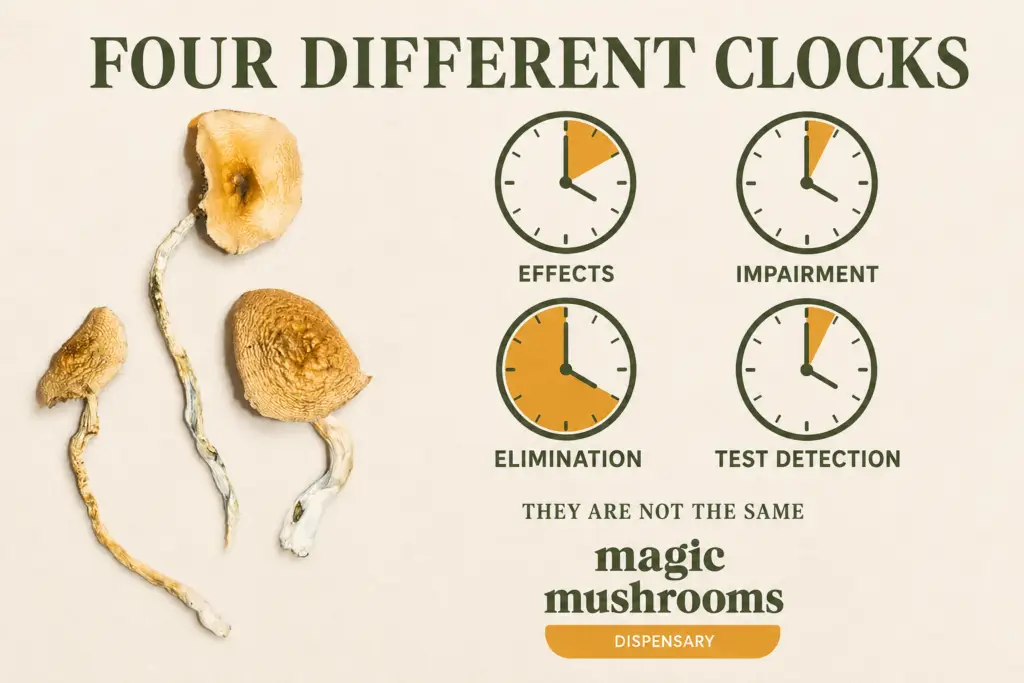
The phrase “in your system” sounds precise, but it can refer to four different timelines. Mixing them together is the main reason online answers conflict.
1. Onset
Onset is the time between taking a product and first noticing effects. It can change with food, format and individual digestion. The complete shroom onset guide covers dried mushrooms, tea, capsules, chocolate and gummies without treating a delayed start as a reason to take more immediately.
2. Subjective effects
This is how long the experience feels active. A typical trip may have several hours of noticeable effects followed by a gradual comedown. The four phases of a shroom trip explains that experience timeline.
3. Impairment
Impairment is the period when perception, coordination, judgment or reaction time may be altered. It may not end at the exact moment visuals or strong sensations fade. Feeling mostly normal is not proof that driving or safety-sensitive work is appropriate.
4. Elimination and test detection
Elimination describes how the body metabolizes and removes a compound. Detection describes whether a particular laboratory method can find an analyte above its cutoff in a particular specimen. A sensitive targeted test may find evidence after obvious effects have ended. A routine panel may never look for that evidence at all.
These clocks overlap, but they are not interchangeable. “The trip is over,” “I am safe to drive,” “the compound has been eliminated” and “a test will be negative” are four different statements.
How the body processes psilocybin
Psilocybin is a prodrug. After ingestion, the body removes a phosphate group and converts it to psilocin, the compound responsible for most of the psychedelic effect. Psilocin is then metabolized into several products, including a glucuronide conjugate that can be measured in urine or blood with appropriate laboratory methods.
A 2025 systematic review of psilocybin pharmacokinetics found elimination half-lives ranging from 1.5 to 4 hours across the studies reviewed. A half-life is the time required for the measured concentration to fall by half. It is not the time required for every trace to disappear, and multiplying a half-life into a universal testing deadline is unreliable.
Researchers have also shown that much of the psilocin found in urine is conjugated as psilocin glucuronide. A classic urine detection study used enzymatic hydrolysis and gas chromatography mass spectrometry to detect it. That detail matters because a laboratory must use a suitable method and know what analyte to target.
For a plain-language explanation of receptors, metabolism and brain effects, read what mushrooms do to your brain.
How long can drug tests detect shrooms?
| Test type | Is psilocybin normally included? | What the evidence supports |
|---|---|---|
| Routine urine panel | Usually no | If psilocybin or psilocin is not on the panel, the test does not report it. Panel contents vary. |
| Targeted urine test | Only when specifically ordered | Detection is most plausible soon after use. Many references discuss roughly the first day, while some give broader estimates. Method and cutoff prevent a guaranteed deadline. |
| Targeted blood test | Only when specifically ordered | Best suited to recent exposure. Free psilocin declines quickly, although newer forensic methods may target more stable metabolites. |
| Saliva or oral fluid | Rarely | There is no well-established consumer window for psilocybin. Routine oral-fluid panels generally target other drugs. |
| Hair | Specialized forensic testing only | Psilocin has been measured in authentic hair samples, but research is limited and routine availability is low. A universal 90-day promise is not justified. |
Important: The table describes general evidence, not a personal prediction. A negative result also does not prove someone was never impaired or never used a substance.
Do shrooms show up on a standard drug test?
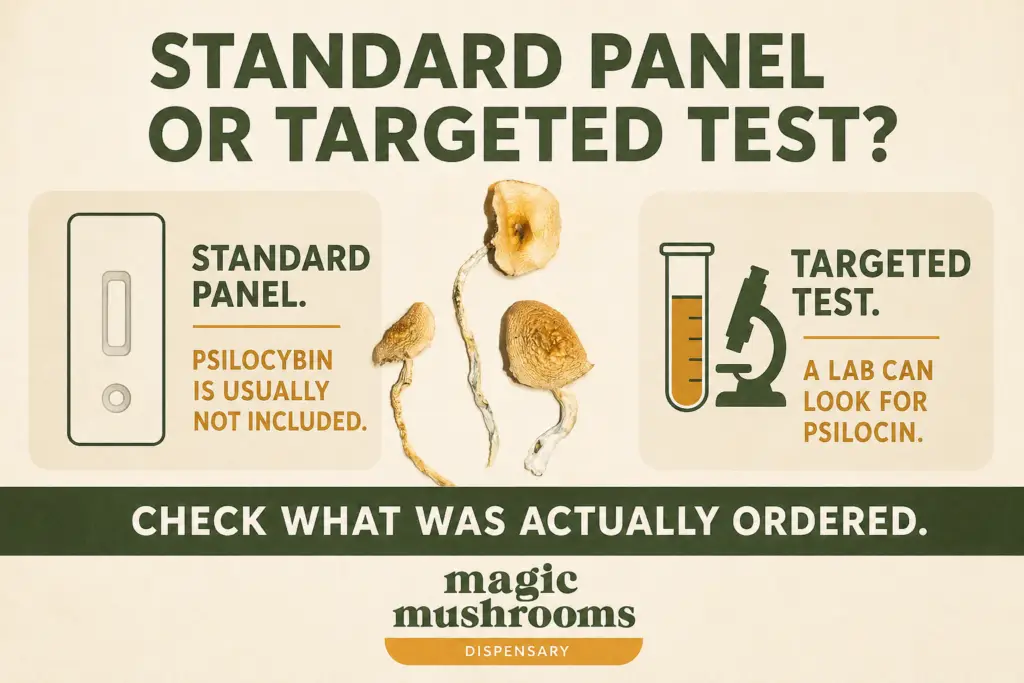
Usually not, because common routine panels are built to screen for other drug classes. For example, the current United States federal workplace program lists amphetamines, cocaine, marijuana, opioids and PCP. Psilocybin and psilocin are not part of those five categories.
That American example is useful for understanding what people mean by a five-panel test, but it is not a universal Canadian standard. Canadian employers, treatment programs, courts, sports organizations and forensic investigators may use different policies and panels. A “10-panel” label also does not guarantee the same ten analytes across every provider.
The useful question is not only “Is this a urine test?” Ask what panel or analytes were actually ordered. A standard immunoassay panel and a targeted mass spectrometry test are different tools.
Can a laboratory test specifically for psilocybin?
Yes. Research and forensic laboratories have methods for psilocin, psilocin glucuronide and, in some settings, psilocybin. Techniques include gas or liquid chromatography paired with mass spectrometry. These tests require appropriate sample handling, validated methods and specific analytical targets. They are not the same as an inexpensive multipanel screening cup.
A 2026 forensic blood study of psilocin glucuronide found the conjugated biomarker was more stable than free psilocin under several storage conditions. This is a good example of why future forensic capability may not match older consumer detection charts.
How long do shrooms stay detectable in urine?
Urine is the specimen people ask about most, but two questions must be separated:
- Does the urine panel include a psilocybin-related target?
- If it does, is the concentration still above that laboratory’s cutoff?
For a routine panel that does not include psilocybin or psilocin, there is no psilocybin result to report. For a targeted test, the best chance of detecting psilocin-related compounds is relatively soon after use because metabolism and elimination are rapid. Many consumer references use about 24 hours as the typical window and some extend estimates to 48 or 72 hours, but direct evidence does not support promising a personal pass time.
Dose, formulation, individual metabolism, specimen concentration, hydrolysis method, storage, cutoff and analytical sensitivity can all change the result. Even two laboratories looking at the same specimen type may not use the same target or reporting threshold.
How long do shrooms stay detectable in blood?
Blood testing is more closely associated with recent exposure than a routine workplace screen. Psilocin reaches measurable blood concentrations after psilocybin is converted, then declines over hours. The 2025 pharmacokinetic review found substantial variation among studies and participants, which is why one clock cannot fit everyone.
Blood samples also create technical challenges. Free psilocin can degrade during storage, while psilocin glucuronide may be more stable. Modern forensic methods can change what a laboratory is capable of finding. That is another reason an older claim such as “undetectable after 12 hours” should not be treated as a guarantee.
Do saliva tests detect shrooms?
Routine oral-fluid tests generally focus on more commonly tested substances, and psilocybin-specific saliva testing is not common. There is also much less practical human evidence supporting a standard saliva window for psilocybin than online charts imply.
Do not assume a mouth swab can never test for a psychedelic. Confirm what analytes and methods are involved. A test designed for one group of drugs says little about what a specialized laboratory could analyze.
Can shrooms show up in a hair follicle test?
What people call a hair follicle test usually analyzes the hair shaft. Drugs and metabolites incorporated into growing hair may provide a longer historical record than blood or urine, but interpretation depends on hair length, sample segment, growth rate, external contamination, cosmetic treatment and the laboratory method.
A 2021 forensic toxicology study developed a highly sensitive method and detected psilocin in two authentic hair samples. Psilocybin itself was not detected in those two samples. That proves specialized hair detection is technically possible. It does not establish a dependable detection rate or universal 90-day window for everyone.
Nail testing is discussed online for similar reasons, but psilocybin-specific evidence and routine availability are limited. Treat precise claims of three or six months cautiously unless they come from the laboratory performing the actual analysis.
What can change a psilocybin detection window?
- The test target: Psilocin, conjugated psilocin and psilocybin are not analytically interchangeable.
- The specimen: Urine, blood, oral fluid and hair represent different biological timelines.
- The method and cutoff: A more sensitive targeted method may detect a lower concentration than a routine screen.
- The amount and potency: A larger exposure can produce higher concentrations, but mushroom potency varies even at the same dried weight.
- Time since use: Concentrations generally fall as metabolism and elimination proceed.
- Individual biology: Enzyme activity, age, health and other drugs may affect pharmacokinetics.
- Sample handling: Light, temperature, storage time and preparation can matter because some analytes are unstable.
Product format can change onset and the experience, but it does not create a guaranteed testing loophole. Dried mushrooms, including Golden Teacher, ultimately expose the body to the same psilocybin pathway as capsules, microdose products and edibles. Read the edible label guide if you need to understand the amount listed per piece versus the package total.
Medication may also change or complicate effects. Do not stop a prescription because of a test or psychedelic plan. The psilocybin and medications guide explains why individual professional review matters.
Can you get shrooms out of your system faster?
There is no proven drink, supplement, sauna routine or detox product that can guarantee a negative psilocybin test. Excessive water can be dangerous and may also produce a diluted specimen that is rejected or flagged under the testing program. Niacin, vinegar, bleach and internet cleanse recipes are not reliable solutions and may cause harm.
The body needs time to metabolize and eliminate compounds. The only dependable way to avoid a positive targeted test is not to use the substance. This article will not provide instructions for defeating specimen validity checks or concealing use.
Workplace testing and driving in Canada
Canadian workplace policies vary by employer, province, industry and whether a role is safety sensitive. Federal guidance notes that workplace testing questions are context specific and that employees have a responsibility to work safely. Review the written policy, union agreement or testing paperwork rather than assuming every workplace uses the same panel.
A test result and impairment are not identical. Someone can be impaired even when a routine panel does not include the substance, and a sensitive test can detect a biomarker after strong subjective effects have faded. Never use “standard tests do not look for it” as permission to work impaired.
Driving has a separate and serious legal standard. Justice Canada states that having any detectable amount of psilocybin or psilocin in the blood within two hours of driving is prohibited. Do not calculate a driving time from a half-life or online detection chart. Plan transportation before use and do not drive while affected.
For broader preparation and risk information, read the Magic Mushrooms Dispensary safety and mental health guide and the first shrooms trip guide.
Frequently asked questions
Do shrooms show up on a five-panel drug test?
Psilocybin and psilocin are not included in the common United States federal five-category panel, which targets amphetamines, cocaine, marijuana, opioids and PCP. Canadian and private testing programs can differ, so check the exact panel rather than relying only on its name.
Do shrooms show up on a 10-panel drug test?
Usually not, but “10-panel” is not a universal ingredient list. The laboratory or ordering organization determines the analytes. Psilocybin requires a specific target and suitable test method.
How long does psilocin stay in the body?
Published human pharmacokinetic research reports an elimination half-life of roughly 1.5 to 4 hours. A half-life is not the same as complete elimination or a guaranteed negative test time.
Can a urine test detect shrooms after 24 hours?
A targeted test may detect psilocin-related compounds after use, but results depend on the method, cutoff, amount, timing and person. Many references describe the first 24 hours as the most relevant period and some use broader estimates. No article can guarantee an individual’s result.
Can a hair test detect one shroom experience?
Specialized researchers have detected psilocin in authentic hair samples, but the evidence base is small. A result depends on incorporation, hair segment, timing and a highly sensitive laboratory method. Routine hair panels may not include it.
Will shrooms cause a false positive for another drug?
A properly confirmed laboratory result uses a specific analytical method rather than treating an initial screen as final. Unexpected results should be reviewed through the testing program’s confirmation and medical review process. Product contamination or undeclared ingredients are separate concerns.
Do microdoses stay in your system for less time?
A smaller exposure may produce lower concentrations, but it does not guarantee a shorter reportable window or a negative result. Test sensitivity, cutoff and timing still matter. A microdose label is not a testing guarantee.
Do chocolate, gummies or capsules change the drug test?
Formats may change digestion and onset, but a targeted laboratory is looking for psilocybin-related compounds or metabolites, not whether the product was chocolate, a gummy, a capsule or dried mushroom.
Can drinking water help pass a psilocybin test?
Normal hydration supports ordinary body function, but excessive water does not guarantee a negative result and can be dangerous. Testing programs may identify a diluted specimen. Detox tricks are not reliable.
Does a negative drug test mean it is safe to drive?
No. Test coverage, detection and impairment are different questions. In Canada, any detectable psilocybin or psilocin in blood within two hours of driving is prohibited. Never use a routine test result or online timeline to decide when to drive.
Bottom line
Most routine drug panels do not include psilocybin, but targeted urine, blood and hair methods exist. Psilocin is eliminated relatively quickly compared with many drugs, yet no single number can promise when every person or every laboratory will produce a negative result.
Find out what test was actually ordered, follow the relevant workplace or legal policy, and do not use a detection estimate to justify driving or safety-sensitive work. For more evidence-led education, visit the Magic Mushrooms Dispensary blog or review the Magic Mushrooms Dispensary homepage. Customers who have completed the necessary safety review can compare current products in the online shop.
Editorial note: This article is educational and is not medical, legal, employment or laboratory advice. It does not help readers circumvent legitimate testing. Evidence and testing methods change, so this page should be reviewed at least every six months. Last evidence review: August 18, 2026.