
Important: Do not stop, skip, reduce or change a prescription because you are considering psilocybin. Medication withdrawal and a return of the condition being treated can be more dangerous than the interaction you are trying to avoid. A physician or pharmacist who knows your medications and health history is the right person to assess your situation.
Psilocybin and medications are not a simple yes or no subject. Some drugs may weaken the subjective effects. Others may increase physical or psychological risk. For many combinations, researchers still do not have enough good human evidence to predict what will happen to a particular person.
This guide organizes the evidence by medication class and provides practical questions for your healthcare professional. It is education, not personal medical advice or permission to combine substances.
The short answer
- Lithium is the clearest warning: published analysis of online reports found a concerning number of seizures and emergency medical events when lithium was combined with classic psychedelics.
- SSRIs and SNRIs may reduce psilocybin effects for some people, but not everyone: the research is mixed and does not make self-directed medication withdrawal safe.
- MAOIs, stimulants, antipsychotics, sedatives and medicines that affect seizure risk need individual review: the exact drug, dose, condition and other substances all matter.
- Health history can matter as much as the medication: bipolar disorder, psychosis, seizures, uncontrolled blood pressure, significant heart disease, pregnancy and breastfeeding require particular caution.
Table of contents
- Why psilocybin drug interactions are complicated
- Medication interaction reference table
- SSRIs, SNRIs and other antidepressants
- Lithium and seizure reports
- Other medication classes
- Health conditions and common contraindications
- Why a do it yourself washout is unsafe
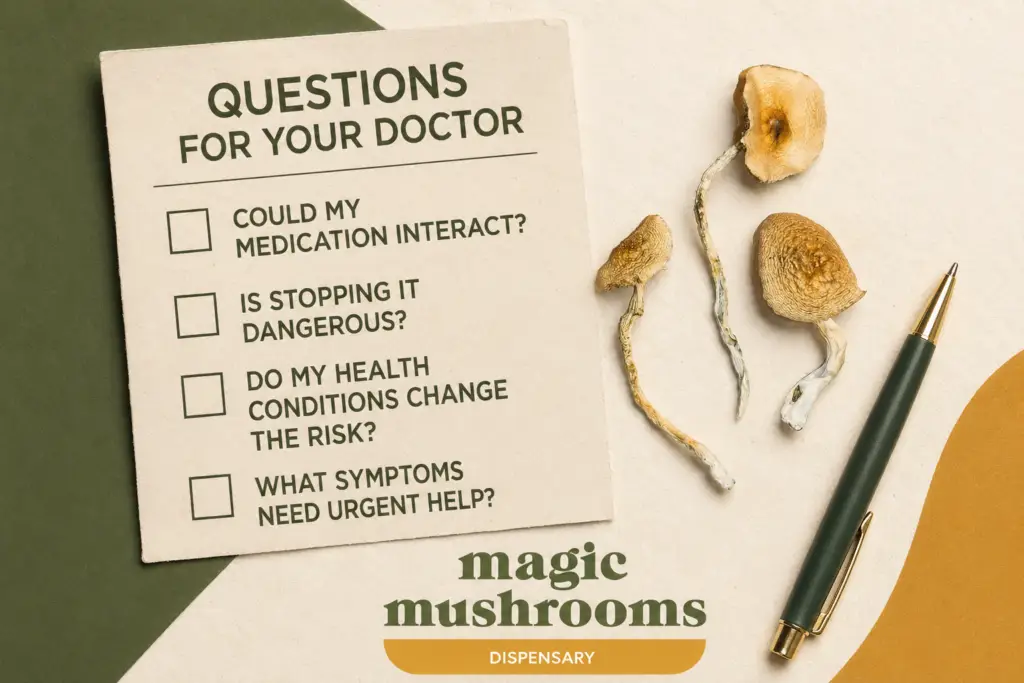
- Questions to ask your doctor or pharmacist
- When to get urgent help
- Frequently asked questions
Why psilocybin drug interactions are complicated
Psilocybin is converted in the body to psilocin, which acts mainly at serotonin 2A receptors. That does not mean every medicine that affects serotonin will interact in the same way. A drug may change receptor sensitivity, alter metabolism, raise heart rate, lower the seizure threshold, reduce anxiety, increase sedation or affect judgment. The reason someone takes the medicine also changes the risk.
A 2024 systematic review of drug interactions with psychedelics found 52 studies from 36 reports. Outcomes ranged from weaker effects to stronger effects or no meaningful change. The authors also emphasized that the evidence is limited. Many modern clinical trials exclude people taking psychiatric medications or require supervised changes before enrollment, so the people most interested in interaction answers are often missing from the data.
Start with the complete Magic Mushrooms Dispensary safety and mental health guide. If you are new to the subject, the first shrooms trip guide explains why screening, support and setting matter before product choice.
Psilocybin and medications: quick reference table
| Medication or substance | What is known or suspected | Practical response |
|---|---|---|
| Lithium | Serious seizure and emergency care reports create the strongest warning signal in the available interaction literature. | Do not self experiment. Speak with the prescriber. Do not stop lithium on your own. |
| SSRIs and SNRIs | Some people report weaker effects, but attenuation is not universal. Safety evidence remains incomplete. | Do not skip doses or taper for a psychedelic experience. Ask the prescriber or pharmacist. |
| Other antidepressants | Effects depend on the mechanism. Evidence for individual drugs is often sparse. | Get a drug specific review, including withdrawal risk and the condition being treated. |
| MAOIs and medicines with MAOI activity | They can substantially change monoamine signaling and interaction risk. Some nonpsychiatric medicines also have MAOI activity. | Treat as a high caution combination requiring qualified professional review. |
| Antipsychotics | Some may blunt psychedelic effects. The psychiatric condition being treated may itself make psilocybin inappropriate. | Do not use or stop an antipsychotic as a do it yourself trip control tool. |
| Benzodiazepines and sedatives | They may reduce anxiety or intensity, but can add sedation, impaired coordination and other risks. | Use only as prescribed. Do not improvise an emergency plan with someone else’s medication. |
| Stimulants, including ADHD medicines | Potential concerns include increased heart rate, blood pressure, agitation and anxiety. | Ask about the exact stimulant and any cardiovascular or anxiety history. |
| Medicines that affect seizure threshold | Risk depends on the medicine, dose, seizure history and other substances. | Professional review is essential, especially with any past seizure. |
| Cardiovascular medicines | Psilocybin can temporarily increase heart rate and blood pressure. A medicine may not fully control that response. | Discuss blood pressure, rhythm problems, chest pain and heart history first. |
| Alcohol, cannabis and other drugs | Mixing can make impairment, anxiety, nausea and judgment less predictable. | Avoid combining substances. One variable at a time is easier to understand and safer to respond to. |
SSRIs, SNRIs and other antidepressants
The evidence on shrooms and antidepressants is developing and sometimes conflicting.
In a 2023 survey of psilocybin experiences reported by antidepressant users, many people taking SSRIs or SNRIs described weaker than expected effects. Some respondents also reported attenuation after discontinuation. The study was based on self-reports, so it cannot establish a safe dose, prove causation or tell one person what will happen.
A more recent scoping review of antidepressants and classic psychedelics found that concomitant use was generally tolerated in the studies reviewed and did not show a clear increase in serotonin toxicity with psilocybin. It also found that weaker effects were not universal. That is reassuring in one respect, but it is not the same as proving every antidepressant combination safe. Study participants are screened, doses are known, and medical support may be available.
Why taking more is not the answer
If an antidepressant seems to blunt the experience, adding more psilocybin is not a controlled correction. Potency and onset still vary, and a larger amount can arrive later with a much stronger peak than expected.
Before assuming medication is the cause, read why shrooms may feel weak or absent and how long different formats can take to begin. Neither guide recommends chasing a delayed or weak experience with rapid redosing.
Why skipping antidepressants is not the answer
Missing doses can produce withdrawal symptoms, sleep disturbance, dizziness, anxiety, mood changes or a return of the condition being treated. Some medicines leave the body quickly while their effects on receptors last longer. Others have long half-lives. There is no universal number of days that makes an unsupervised washout safe.
Do not use a blog, forum or psychedelic retreat checklist to design a taper. Ask the prescriber what interruption could do, how long the medicine remains active and whether your underlying diagnosis changes the decision.
Lithium and psychedelics deserve a separate warning
Lithium is not simply another antidepressant. It is commonly used in bipolar disorder and other serious mood conditions, and the available interaction signal is concerning.
A 2021 analysis of online psychedelic experience reports identified 62 reports involving lithium. Forty-seven percent involved seizures and 39 percent involved medical attention. Online reports cannot establish the rate of harm because the denominator is unknown, the substances may not be verified and adverse experiences are more likely to be posted. Even with those limits, the pattern is serious enough that the authors concluded lithium may carry significant seizure risk with classic psychedelics.
A 2024 scoping review of psychedelics and seizures described the overall evidence as heterogeneous and noted that other substances, including lithium, may increase risk. The practical message is conservative: do not self experiment with lithium and psilocybin, and do not stop lithium to make the combination possible.
If lithium is on your medication list, tell the prescriber exactly what you are considering. If the answer is no, taking less psilocybin does not turn an inadequately studied high risk combination into a safe one.
What about other medication classes?
MAOIs and medicines with MAOI activity
Monoamine oxidase inhibitors can substantially change the metabolism and signaling of monoamines. This category includes psychiatric MAOIs, but medication reviews should also look for nonpsychiatric drugs with MAOI properties, such as linezolid or methylene blue in certain medical settings. Do not rely on a product label that says only natural ingredients or on a list that covers prescription antidepressants but ignores other medicines.
This is a high caution area for individual professional assessment. Avoid internet recipes that intentionally add MAOI containing plants to prolong or intensify an experience.
Antipsychotic medicines
Some antipsychotics block serotonin 2A receptors and may reduce psychedelic effects. That mechanism does not make them a safe do it yourself trip stopper. Sedation, blood pressure changes and other effects still matter. More importantly, a history of psychosis, schizophrenia or some bipolar presentations is commonly excluded from psilocybin trials because of concern about psychiatric destabilization.
Never stop an antipsychotic to feel more from psilocybin. Never take another person’s antipsychotic to end an experience. Both choices introduce new risks without medical assessment.
Stimulants and ADHD medication
There is much less direct research on psilocybin and individual ADHD medications than online discussions suggest. The concern is not just serotonin. Prescription stimulants can raise heart rate and blood pressure or increase restlessness and anxiety. Psilocybin can do some of the same things temporarily. Nonstimulant ADHD medicines have different mechanisms and need their own review.
Give the pharmacist the exact name, dose and schedule. Saying only that you take ADHD medication is not specific enough for a useful answer.
Over the counter medicines, supplements and recreational substances
A complete review includes more than prescriptions. Cough and cold products, sleep aids, antihistamines, migraine medicines, herbal products and supplements can matter. Bring the labels and disclose alcohol, cannabis, stimulants and other drugs honestly.
Health Canada warns that combining magic mushrooms with substances such as cannabis, amphetamines or alcohol can increase the risk of serious effects. Read the existing guides on shrooms and alcohol and psilocybin and cannabis, but use them as harm reduction education, not a mixing plan.
Who may be at higher risk even without medication?
Medication is only one part of screening. Health Canada notes that effects depend on a person’s age, mood, expectations, environment, medical and psychiatric conditions, previous experience and combined use with other drugs.
Common clinical trial exclusions are useful warning signs, but they are not a diagnosis or a complete list. A qualified professional should review:
- a personal or close family history of psychosis, schizophrenia or mania;
- bipolar disorder or episodes of unusually elevated mood, reduced need for sleep or risky behavior;
- a seizure disorder, unexplained blackout or previous substance related seizure;
- uncontrolled high blood pressure, serious heart disease, rhythm problems or a recent cardiovascular event;
- active suicidal thoughts, severe depression, panic or another unstable mental health condition;
- pregnancy or breastfeeding, where adequate safety evidence is lacking;
- significant liver or kidney disease that may alter medication handling;
- multiple prescriptions, recent medication changes or a recent psychiatric hospitalization.
Do not create your own medication washout
A washout period is not a generic countdown. It depends on the drug’s half-life, active metabolites, dose, duration of use, withdrawal profile, the person’s health and why the medicine was prescribed. Even when a clinical study pauses a medication, that decision happens under a protocol with screening and monitoring.
Do not:
- skip the morning dose because a forum says the interaction will be weaker;
- cut tablets or open capsules without instructions;
- replace a prescription with a supplement;
- increase psilocybin to overpower a medication;
- borrow a sedative or antipsychotic as a backup;
- hide planned use from the professional managing your care.
If you feel uncomfortable asking your physician, a pharmacist can still review interaction mechanisms and withdrawal concerns.
Questions to ask your doctor or pharmacist
You do not need to arrive with a scientific argument. You need an accurate list and a direct question. A useful opening is:
“I am considering psilocybin and want an honest safety review. These are all the medications, supplements and substances I use. Could any of them interact, and would changing any prescription create withdrawal or relapse risk?”
Then ask:
- Could any of my medicines change psilocybin’s psychological or cardiovascular effects?
- Does any medicine on my list affect seizure threshold or serotonin signaling?
- Does my diagnosis create a risk that is separate from the medication?
- Would missing or reducing a dose cause withdrawal, rebound symptoms or relapse?
- Are any over the counter medicines or supplements relevant?
- Do my blood pressure, heart rhythm, liver or kidney health change the risk?
- Does my personal or family history of mania, psychosis or seizures matter?
- What symptoms would require emergency help?
- Is there a legal, supervised research or clinical option appropriate for my situation?
What to bring to the appointment
Bring the exact name, dose and schedule of every prescription, plus photos of supplement and over the counter labels. Include recent medication changes, relevant diagnoses, previous reactions and honest information about alcohol, cannabis or other drugs.
A professional may still say the evidence is uncertain. That is useful information. Uncertainty is not permission to improvise, particularly with lithium, unstable psychiatric symptoms, seizure history or serious cardiovascular disease.
Product choice cannot solve a medication interaction
A gentler strain, microdose label or edible format does not cancel a contraindication. A low stated amount is not a medical guarantee. The article on what different dried mushroom weights may feel like explains why grams measure weight rather than exact psilocybin content.
If a qualified professional has reviewed your situation and you are legally able to proceed, understand the format before purchase. Compare clearly described dried mushrooms, capsules, microdose products and edibles.
Magic Mushrooms Dispensary provides product information and education, not personal medical clearance. The safest conversion path on this page is education first, professional review second and shopping only if the result supports it. Visit the Magic Mushrooms Dispensary homepage, the complete online shop or the education centre when you are ready to compare formats with clear expectations.
When to get urgent help
Call 911 for a seizure, loss of consciousness, severe chest pain, trouble breathing, signs of stroke, dangerous overheating, extreme agitation, violent behavior, suicidal behavior or a person who cannot be kept safe. Tell responders what was taken, when it was taken and every medication or substance involved. That information helps treatment.
Frequently asked questions about psilocybin and medications
Can I take shrooms while on an SSRI?
Some evidence suggests SSRIs may weaken subjective effects for some people, while other studies do not find consistent attenuation or major safety problems. The exact SSRI, dose, diagnosis and other medications matter. Do not skip or taper an SSRI on your own. Ask the prescriber or pharmacist for an individual review.
Can I take shrooms while on an SNRI?
Survey data also suggest possible weaker effects with SNRIs, but the evidence does not establish a safe combination or a dose adjustment. SNRIs can have significant discontinuation symptoms. Do not interrupt treatment to change a psychedelic response.
Why is lithium a major concern with psychedelics?
Published analysis of online reports found a notable pattern of seizures and emergency medical care with lithium and classic psychedelics. The reports have important limitations, but the signal is serious. Do not combine them as a self experiment or stop lithium without the prescriber.
Can antidepressants cause serotonin syndrome with psilocybin?
Current reviews have not shown a clear serotonin toxicity signal for psilocybin with SSRIs or SNRIs in the limited studies available. That does not prove all serotonergic combinations are safe. MAOIs and other medicines with complex serotonergic effects require particular caution and professional assessment.
How long should I stop medication before taking shrooms?
There is no universal washout period, and this guide will not provide one. Half-lives, active metabolites, withdrawal risk and the treated condition differ greatly. Only the clinician managing the medicine can assess whether a change is appropriate.
Can ADHD medication be mixed with psilocybin?
Direct evidence for individual ADHD medicines is limited. Stimulants may add concerns about heart rate, blood pressure, anxiety or agitation, while nonstimulants work differently. Give the pharmacist the exact medication and dose rather than relying on the broad ADHD label.
Can antipsychotics stop a bad trip?
Some antipsychotics may reduce psychedelic effects, but they can also cause sedation, blood pressure changes and other adverse effects. Do not take someone else’s prescription or change your own as a home trip control strategy. Severe symptoms require professional help.
Are microdoses safe with medication?
A smaller amount does not erase an interaction, and commercial microdose strength is not a medical standard. The medication, diagnosis, cardiovascular health, seizure history and other substances still matter. Read what microdosing means, then ask a professional about your own list.
Can I ask a pharmacist instead of my doctor?
Yes. Pharmacists are medication experts and can review mechanisms, duplicate effects, half-lives and withdrawal concerns. Your physician may be better placed to assess the diagnosis and full medical history, so both may be useful.
What if I already combined psilocybin with medication?
Do not take more or add another substance to control the experience. Stay with a calm sober person, avoid driving and monitor for severe symptoms. Call 911 for a seizure, loss of consciousness, severe chest pain, trouble breathing, dangerous agitation or any situation where the person cannot be kept safe.
Bottom line
Psilocybin drug interactions range from possible attenuation to serious warning signals, and the quality of evidence differs by medication. Lithium deserves the strongest caution because of reported seizures. Antidepressants require a more nuanced answer: effects may be weaker for some people, but stopping treatment is not a safe workaround and safety data are still limited.
Write down every medicine, supplement and substance you use. Ask a physician or pharmacist about the exact list, your diagnosis and your health history. Read the complete safety guide, and treat uncertainty as a reason to pause rather than a gap to fill with guesswork.
Editorial note: This article is educational and does not replace medical advice. It was reviewed against Health Canada information and peer reviewed interaction literature available on August 18, 2026. Because medication evidence changes, review this page at least every six months and after major new clinical guidance.